Why India Is a Major Bagasse Packaging Supply Base
India supplied 4.8% of US molded fibre tableware imports by May 2026, up from 0.9%, on US Census data. Structural advantages, JNPT logistics and what to verify.
On this page
Sourcing in bulk?
Tell us your products and quantity
We supply distributors and brands in 30+ countries, and reply with pricing, lead time and shipping.
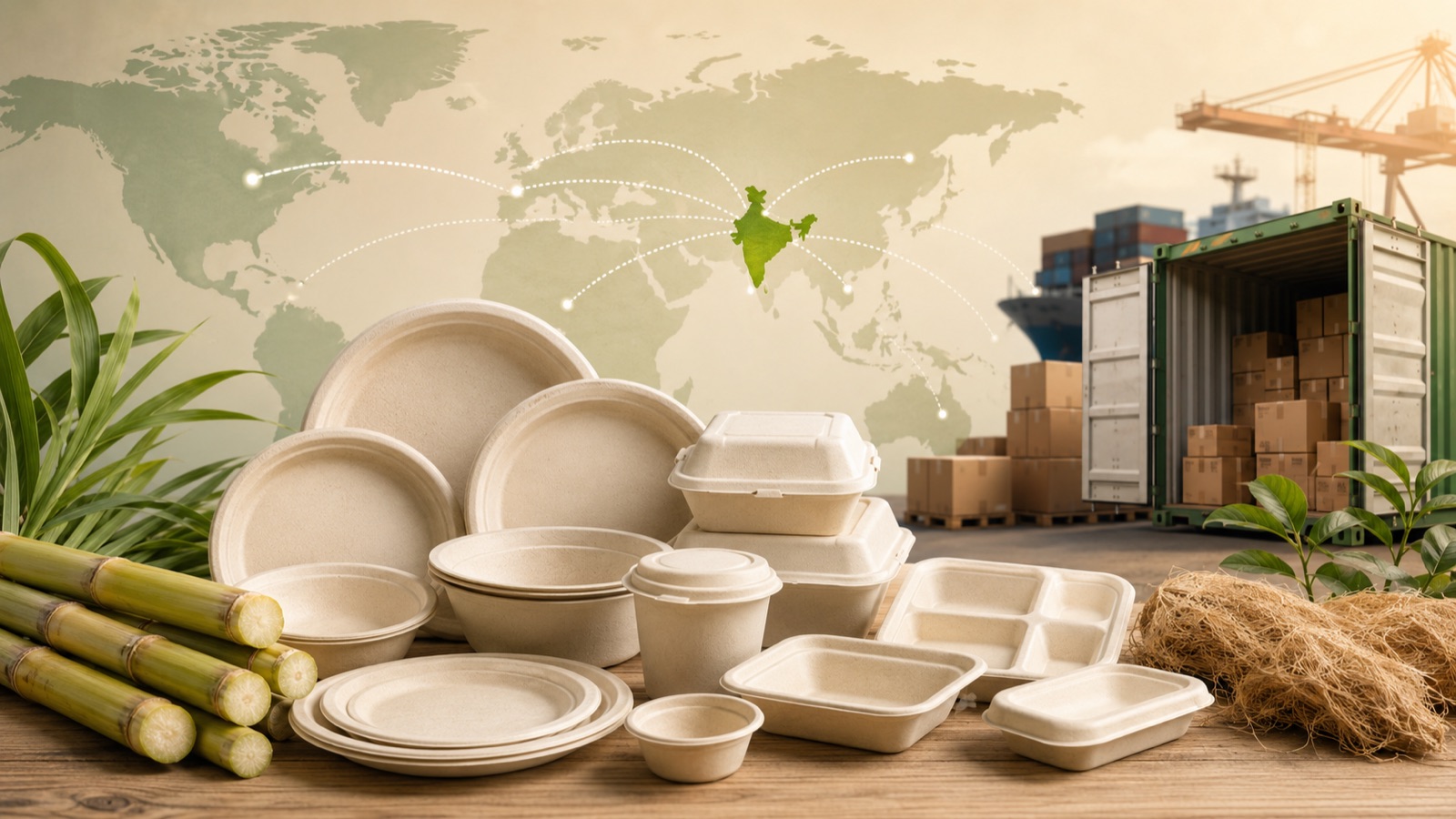
India is a significant and growing supply base for compostable molded fiber packaging, though not the largest by volume into every market. On US Census figures for moulded fibre tableware (HS 4823.70.0020), India’s share of US imports rose from 0.9% in January 2025 to 4.8% by May 2026. Over the same period China fell from 67.8% to 3.9% following the antidumping and countervailing orders, and Thailand rose from 0.7% to 44.4%, taking most of the displaced volume. Global production share is not centrally tracked, so treat any single worldwide percentage as an estimate.
For procurement teams in the U.S., EU, UK, and MENA evaluating supplier geography, the practical question is where capacity, raw material, and compliance documentation concentrate, and India scores well on all three.
US buyers should also read our guide to the 2026 US duty orders on molded fiber tableware, which apply to Chinese and Vietnamese origin and not to Indian manufacture.
Key takeaways
- India’s bagasse cost advantage comes from sugarcane-adjacent raw material (a waste stream) and manufacturing clustered near sugar mills.
- Maharashtra manufacturers export through Nhava Sheva (JNPT), with direct routing west to the Middle East, Europe, and Africa.
- Buyers are diversifying from China on tariff exposure and more consistent compliance documentation.
- Evaluate Indian suppliers on certification depth (BRCGS, FDA, EN 13432), capacity, and documentation, not price alone.
The structural advantage: bagasse is a sugarcane by-product
Bagasse is the dry pulpy residue left after sugarcane stalks are crushed for juice. India is among the world’s largest sugarcane producers (~400 million tonnes annually), generating a large volume of bagasse residue. Most of this residue is burned for power generation in sugar mills. A meaningful and growing share now goes into molded fiber packaging.
Three structural advantages flow from this:
- Raw material cost: Bagasse is a waste stream, not a primary crop. Pricing remains relatively insulated from agricultural commodity cycles.
- Geographic clustering: Sugar mills are concentrated in Maharashtra, Uttar Pradesh, and Tamil Nadu. Manufacturing facilities locate near the mills, reducing inbound logistics cost.
- Vertical integration: Larger Indian manufacturers operate within or adjacent to sugar mill complexes, controlling raw material supply end-to-end.
Export logistics: Nhava Sheva (JNPT) and the shift west
Maharashtra-based manufacturers (including Ecofy) export through Nhava Sheva (JNPT) in Mumbai, India’s largest container port and a direct route to Europe, Africa, and the Middle East via the Suez Canal.
Container capacity out of JNPT has expanded since 2023, led by the ramp-up of Bharat Mumbai Container Terminals (BMCT) alongside the established Nhava Sheva International Container Terminal (NSICT) and Nhava Sheva International Gateway Terminal (NSIGT). Transit times are carrier and routing dependent, so the ranges below are typical rather than guaranteed.
| Destination | Typical FCL transit | Routing |
|---|---|---|
| Jebel Ali (UAE) | 5-8 days | Direct via Arabian Sea |
| Felixstowe (UK) | 21-28 days | Via Suez |
| Rotterdam (EU) | 22-30 days | Via Suez |
| New York (US East Coast) | 28-35 days | Via Suez |
| Long Beach (US West Coast) | 30-38 days | Via Pacific |
Confirm current schedules with your carrier; Red Sea diversions and seasonal capacity can shift these materially.
Why buyers are diversifying away from China
Three forces accelerated the shift toward Indian bagasse suppliers between 2022 and 2026:
- Tariff exposure: US Section 301 tariffs on Chinese-origin packaging created cost pressure that Indian-origin goods largely escaped. Since 24 July 2026 the separate Section 301 forced-labour action reaches both, but it places India in the 10 percent tier and China, Thailand and Vietnam in the 12.5 percent tier, so the gap narrowed rather than closed. See the US import duty breakdown by origin.
- Compliance documentation depth: Major bagasse tableware manufacturers in India now hold BRCGS, FDA, EN 13432, and Sedex certifications consistently. China retains a longer compliance tail with significant supplier-to-supplier variance.
- Geopolitical hedging: Multinationals adopting “China + 1” sourcing strategies treat India as the natural primary alternative for packaging categories.
What to evaluate when sourcing Indian bagasse
Not every Indian bagasse supplier operates at export-grade procurement standards. For how the named players compare on plant location, published capacity and certification, see our review of which Indian bagasse producers publish what. The 10-point checklist procurement teams should run:
- BRCGS Packaging Materials certification (Grade A or A+ ideal)
- FDA documentation for U.S. shipments
- EN 13432 compostability certificate (current, not expired)
- FSSAI registration (India domestic) and SGS / Intertek lab reports
- Sedex SMETA audit for ESG documentation
- FCL minimum order quantity and lead time clarity
- Single-site or multi-site manufacturing (single-site offers consistency advantage)
- Distance to nearest port (Chhatrapati Sambhajinagar (Aurangabad)-based facilities ship through JNPT efficiently)
- Custom tooling capability and lead time
- Multi-lab independent testing (not just self-certified)
Ecofy operates a 150,000 sq ft single-site facility in Chhatrapati Sambhajinagar (Aurangabad), Maharashtra, built to BRCGS Packaging Materials Grade A standard, with multi-lab certification across CIPET, SGS, Intertek, FDA, and Sedex. The catalogue spans plates, bowls, trays, clamshells, and takeaway containers, with container-load exports through JNPT to 30+ countries. See the full product range.
Once you have shortlisted a supplier, our guide on how to import bagasse tableware from India covers HS-code classification, customs documents, and the certifications to demand for each market.
Evaluating Indian bagasse suppliers? Request a sample to assess quality and documentation before committing to an order.
Want guides like this in your Google results?
Add Ecofy as a preferred source. Google will surface our compliance standards and trade-data guides more often when you search packaging rules, including in AI Overviews. Takes one click and you can remove it any time.