How to Import Bagasse Tableware from India: A Buyer's Guide
HSN code 4823.69 for bagasse plates and tableware, plus duties, certifications, customs documents and Incoterms for importing from India.
On this page
Sourcing in bulk?
Tell us your products and quantity
We supply distributors and brands in 30+ countries, and reply with pricing, lead time and shipping.
Quick answer: To import bagasse tableware from India, classify it under HS heading 4823 (usually 4823.70), demand the right food-safety and compostability certifications, prepare a commercial invoice, packing list, bill of lading and certificate of origin, agree an Incoterm such as FOB, CIF or DDP, and confirm your destination duty with a customs broker.
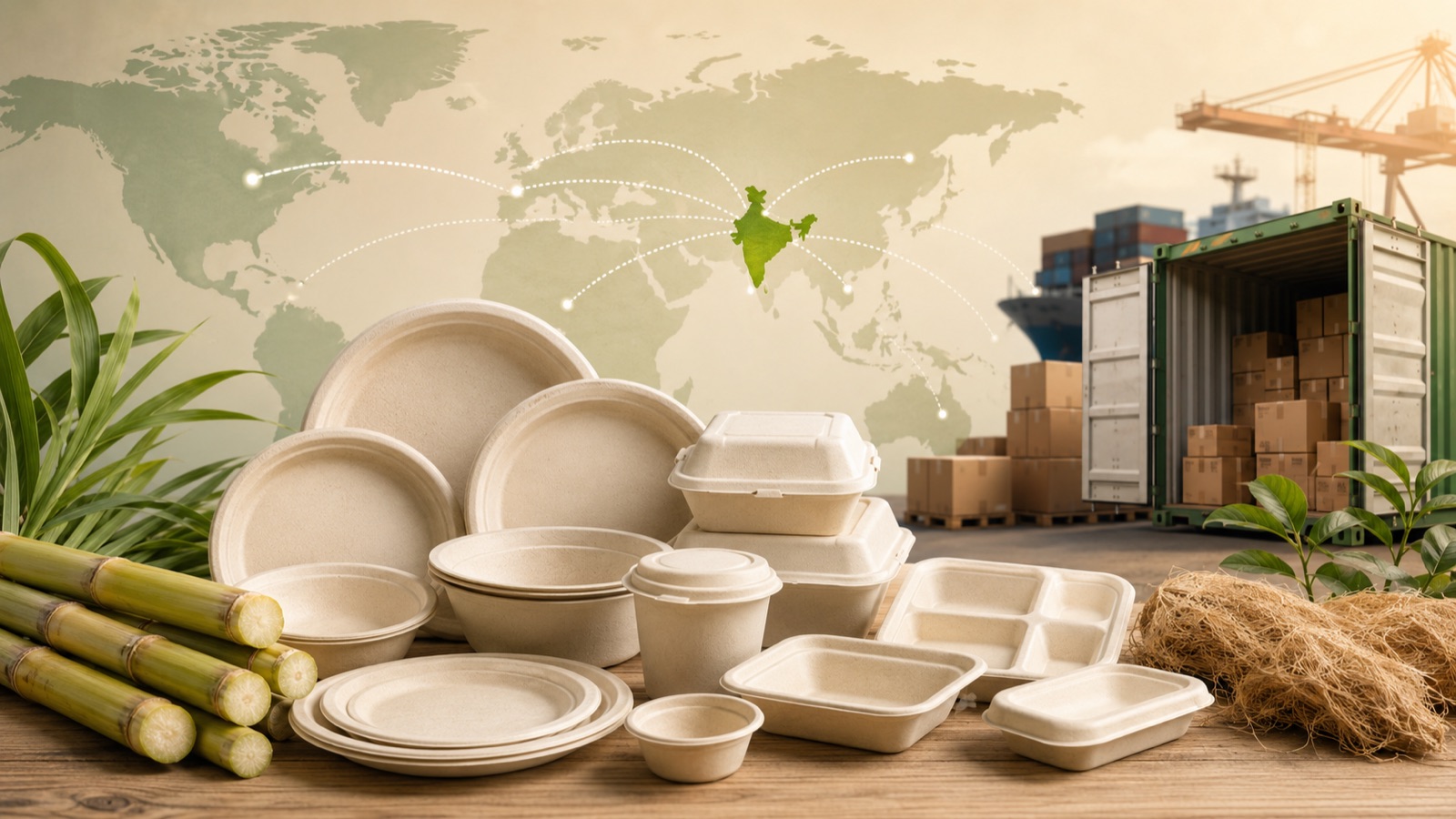
The United States, United Arab Emirates and United Kingdom together take the largest share of the compostable tableware India exports, driven by expanding single-use-plastic bans. Our UK moulded fibre import data shows India held 5.1 percent of that market and who the incumbent suppliers are. If you are a distributor, importer or foodservice buyer planning your first order, the process is straightforward once you know four things: how the product is classified for customs, which certifications to demand, what documents clear the shipment, and how the commercial terms work. This guide walks through each, market by market, so you can source bagasse tableware from India with confidence.
Key takeaways
- You can import the full range in one mixed container: plates, bowls, meal trays, clamshells, takeaway containers and PET lids.
- Classify it correctly. Molded-fibre bagasse tableware sits under HS heading 4823 (commonly 4823.70). The HS code, not the word “compostable”, decides duty and clearance.
- Demand the documentation up front. Ask for BRCGS, food-contact test reports, a compostability report and a PFAS-free declaration before you shortlist a supplier.
- Compliance is market-specific. The USA works on FDA 21 CFR plus state PFAS rules, the EU and UK on migration rules plus EN 13432, and India on FSSAI.
- Documents are part of the product. A commercial invoice, packing list, bill of lading and certificate of origin clear the goods.
- Pick the right Incoterm. DDP is simplest for a first import; FOB gives you the most control. See our FOB vs CIF vs DDP guide for how each term works.
Why source bagasse tableware from India
India is one of the world’s largest sugarcane producers, which means an abundant, low-cost supply of the raw fibre that molded-fibre tableware is pressed from. Combined with mature manufacturing and container-load export logistics through ports like Nhava Sheva (JNPT), that makes India a primary origin for compostable tableware worldwide. For the fuller picture on the supply chain and why it concentrates here, see our guide on why India leads bagasse packaging supply.
The practical takeaway for a buyer is that you get competitive factory-direct pricing at container scale, but the responsibility for classification and compliance sits with you as the importer of record. The rest of this guide covers exactly that.
What bagasse tableware you can import from India
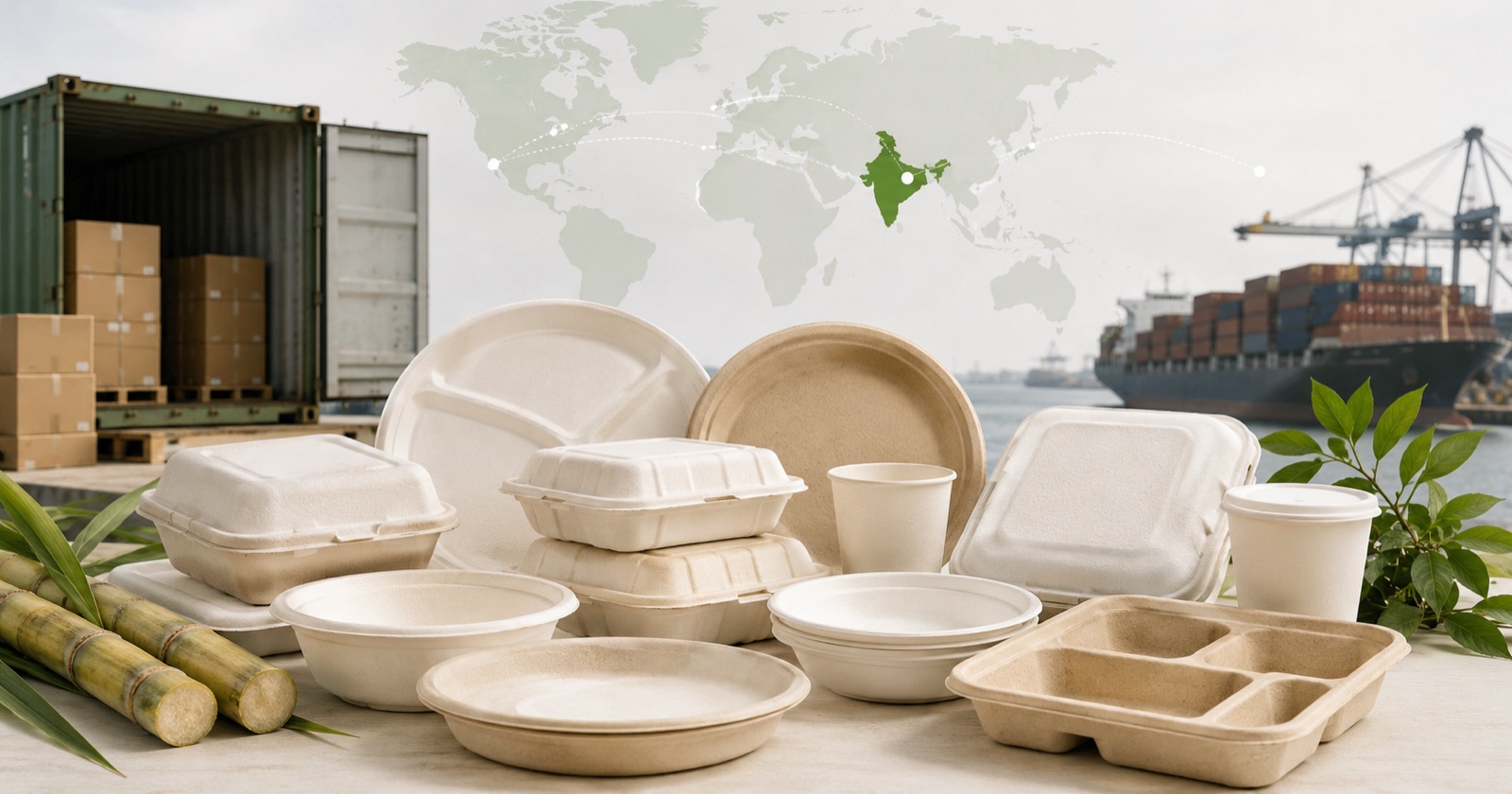
Indian molded-fibre factories produce the full foodservice range, and because the products are light you can mix several categories into one container. The categories buyers import most:
- Plates, round and compartment, from small sides to large dinner sizes
- Bowls, in a range of capacities for soups, salads and grain bowls
- Meal trays, including compartment and school-meal trays
- Clamshells, hinged burger and meal boxes
- Takeaway containers for delivery and grab-and-go
- PET lids to pair with bowls and containers
Importers typically move these into foodservice segments from QSR and cloud kitchens to hotels and HORECA and cafes and coffee shops. Browse the full product range or build a sample kit to shortlist the exact SKUs before you plan an order.
How bagasse tableware is classified for customs (HS and HSN code)
Every imported product is cleared against a Harmonized System (HS) code, the global classification maintained by the World Customs Organization. HS headings are assigned by material and form, not by marketing language, so “eco-friendly” or “compostable” does not appear in the code.
Molded-fibre and bagasse tableware is generally classified under:
- HS heading 4823, and most commonly 4823.70, for molded or pressed articles of paper pulp (which is what bagasse tableware is).
HS code and HSN code mean the same thing here. HSN stands for Harmonised System of Nomenclature, which is the Indian name for the same World Customs Organization system. So a buyer looking up the bagasse plates HSN code and an importer looking up the HS code are asking about one classification, not two. India then extends the heading to eight digits under its ITC-HS schedule.
Three points matter for planning:
- Each country extends the code. The first six digits are global; your destination adds further national digits, so the full code you clear on will be longer. The US uses the HTS (10 digit), the EU the Combined Nomenclature and TARIC, the UK its own Trade Tariff, India the ITC-HS, and GCC states their unified tariff. Confirm the exact code with a licensed customs broker in your market.
- Get it right on the commercial invoice. The HS code drives your duty rate and your clearance path. A wrong code causes delays and can trigger reassessment.
- Do not lift an eight-digit HSN code from a tariff-lookup website. Commercial directory sites publish conflicting eight-digit subdivisions beneath 4823 70 for moulded pulp articles, and they are not the legal authority. Only the CBIC customs tariff schedule, or a licensed broker reading it, settles which subdivision your SKUs actually clear on.
Certifications to demand from your supplier
This is where most first-time imports go wrong. A claim on a website is not proof. Before you shortlist any Indian supplier, ask them to produce the actual documents, and check them where you can. A genuine factory-direct manufacturer keeps these ready. You can see the full set Ecofy publishes, with the issuing bodies and report numbers, on our certifications and test reports page. For the complete vetting process, separating a real manufacturer from a trader, the documents to demand, and the red flags that should stop a deal, follow our checklist for choosing a compostable tableware supplier.
The documents that matter to a buyer:
- Facility food safety: BRCGS Packaging Materials certification. This is a whole-site audit, not a single test, and it is what large retail and foodservice buyers ask for at the evaluation stage.
- Food-contact safety: migration test reports to FDA 21 CFR 176.170 for the USA and EU Regulation 10/2011 for Europe, from an accredited lab such as SGS or Intertek.
- Compostability: a report to ASTM D6868 or EN 13432 methods, showing disintegration and biodegradation results.
- Plastic-free / PFAS-free: a declaration, backed by testing, that the product carries no PFAS or fluorochemical coatings.
- India food safety: FSSAI documentation, relevant if you also sell within India.
If a supplier cannot show these, treat it as a red flag rather than a paperwork delay.
Compliance by destination market
The certifications above are universal, but each export market enforces a different rulebook. Match your documentation to where the goods are going.
- •FDA 21 CFR 176.170
- •PFAS-free (state bans)
- •ASTM D6868 / BPI
- •Correct HTS code
- •EU 10/2011 + 1935/2004
- •REACH (SVHC)
- •EN 13432 (compostable)
- •Outside UK Plastic Tax scope
- •FSSAI (IS 6615)
- •ESMA SUP phase-out
- •Food-contact safety
- •Compostability report
United States
Food-contact articles must comply with FDA 21 CFR, and for molded fibre the relevant part is 21 CFR 176.170. Ask for an SGS or Intertek test report confirming a pass. Separately, a growing list of states, including California and Maine, ban intentionally added PFAS in foodware, so a PFAS-free declaration is effectively required. To label a product “compostable” for US commercial composting, buyers commonly look for BPI certification, which is built on the ASTM D6400 or D6868 standards. Full context is in our FDA food-contact guide and on the USA market page.
European Union and United Kingdom
Food-contact compliance runs on framework Regulation 1935/2004 and plastics Regulation 10/2011 migration testing, plus REACH on substances of concern. To market goods as compostable, the recognised standard is EN 13432, which the EU Packaging and Packaging Waste Regulation reinforces. In the UK, uncoated bagasse sits outside the scope of the UK Plastic Packaging Tax, a documented saving worth flagging to your own buyers. See the UK market page and the EN 13432 guide.
India and the GCC
For sale within India, packaging must meet FSSAI rules for food-contact material, based on the relevant Indian Standard. Distributors buying for sale inside the country should start with our page for bagasse packaging manufacturers in India. In the UAE and wider GCC, food-contact safety plus the single-use-plastic phase-out are the drivers, and buyers generally accept SGS food-contact and compostability reporting. See the UAE market page for the regional detail.
Customs documents you will need
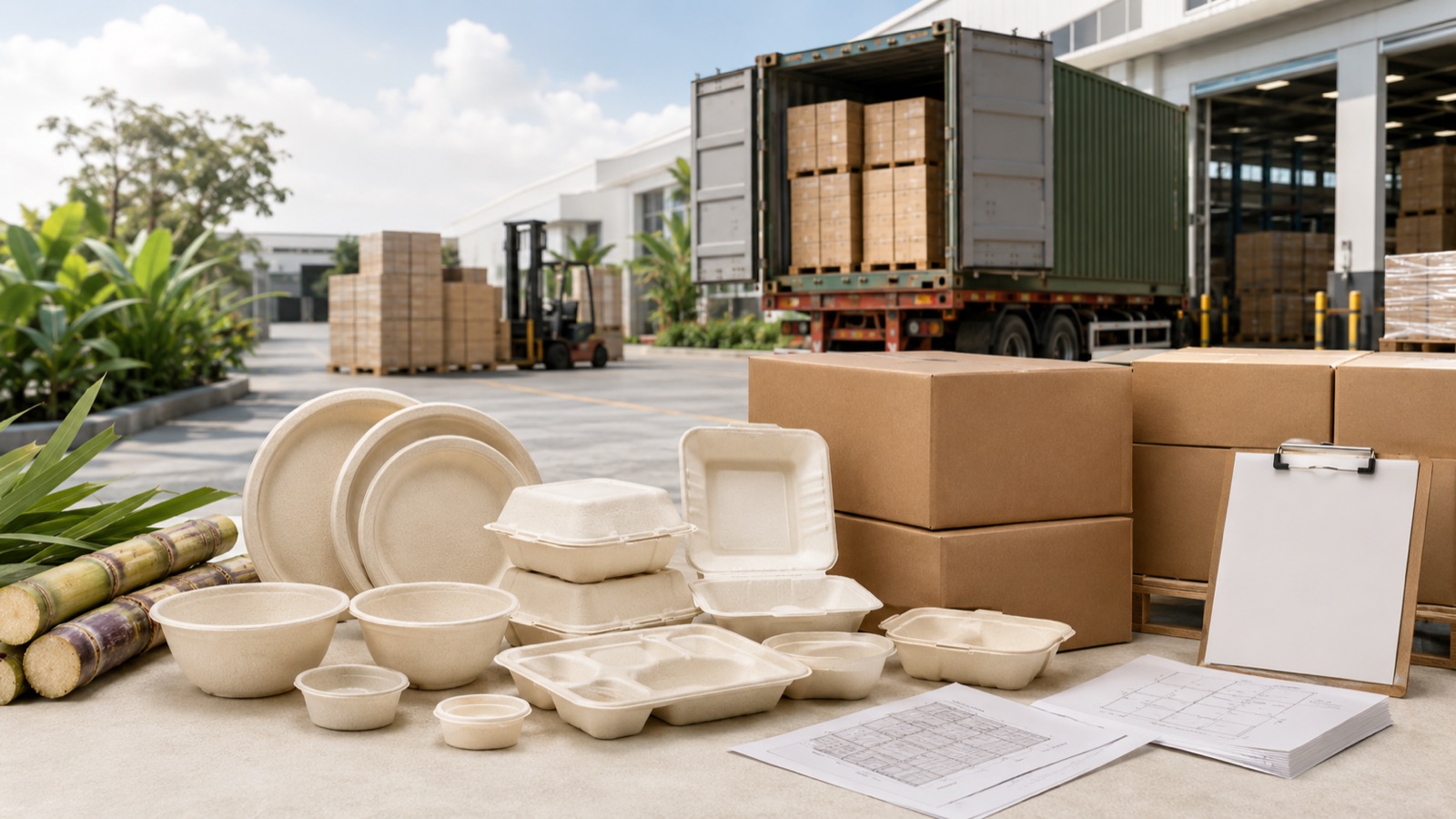
Treat the document pack as part of the shipment, because it is what releases the goods. For a compostable tableware import, expect to handle or receive:
- Commercial invoice, showing value, HS code, and Incoterm
- Packing list, itemised by SKU with carton and pallet detail
- Bill of lading, the ocean carrier’s document of title
- Certificate of origin, confirming the goods are of Indian origin
- Compliance certificates for your market, as covered above
On a DDP quote the supplier arranges most of this and delivers to your door. On FOB or CIF you or your customs broker handle clearance at destination.
Import duty and landed cost
If you are importing into the United States, read the US import duty on molded fiber tableware guide first. Antidumping and countervailing duty orders have applied to thermoformed molded fiber tableware from China and Vietnam since January 2026, and they change the landed-cost comparison between origins.
Duty is set by your destination country’s tariff schedule against the HS code, not by the supplier, so the same product can carry a different rate in the USA, the EU and the UAE. Do not plan landed cost from the product price alone. Build it from the ex-works or FOB price, plus freight and insurance, plus duty and any local taxes, plus clearance and inland delivery. Use the correct HS heading as your starting point and confirm the live rate with a licensed broker in your market before you commit to a purchase order.
How your landed cost builds up
Illustrative only. Actual proportions vary by product, lane and destination tariff.
For how MOQ, container loading and FOB versus CIF versus DDP feed into that landed cost, our MOQ, lead time and container planning guide has the working method and the container-loading math.
Step by step: from quote to delivered container
- 1Quote & sample
- 2Verify certs
- 3Place PO
- 4Production, 2 to 4 wks
- 5Docs & inspection
- 6Ship & clear customs
- Shortlist SKUs and request a sample kit. Check quality on the exact items before committing. You can build a sample kit to shortlist.
- Verify certifications. Ask for the documents in the section above and check them independently where possible.
- Agree specs, MOQ and Incoterm. Confirm pieces per carton, minimums per SKU, and whether the price is FOB, CIF or DDP.
- Confirm the HS code and duty for your market with your customs broker.
- Place the purchase order and approve the pre-production sample.
- Production and documentation, followed by pre-shipment inspection if you require it.
- Shipment and clearance, with the document pack travelling with the goods.
How to vet a supplier in India
Our comparison of nine named Indian manufacturers compared applies that filter to nine named companies. The single most useful filter is factory-direct versus trader. A factory-direct manufacturer controls quality, certification and lead time; a trader adds a margin and a layer of distance from the source. Before you commit:
- Confirm they manufacture, and ask which certifications are in their own company name.
- Check the certifications independently. A BRCGS certificate, for example, can be verified on the certifying body’s public directory.
- Order samples of the exact SKUs, not a generic kit.
- Get MOQ, pieces per carton, Incoterm and lead time in writing.
- Confirm export experience to your market and port, since documentation and lane times differ.
Get an import-ready quote
Tell us your SKUs, destination port and preferred Incoterm, and we will return MOQ, pieces per carton, container quantities, lead time, and the full certificate pack matched to your market. Request a quote or explore wholesale bagasse tableware supply to get started. Importing under your own brand? See OEM and private-label supply.
Want guides like this in your Google results?
Add Ecofy as a preferred source. Google will surface our compliance standards and trade-data guides more often when you search packaging rules, including in AI Overviews. Takes one click and you can remove it any time.