EN 13432 Compostability Standard: Buyer's Guide
EN 13432 European compostability explained. Testing requirements, how to verify supplier claims, EU Pkg Reg 2025 and UK Plastic Tax implications.
On this page
Sourcing in bulk?
Tell us your products and quantity
We supply distributors and brands in 30+ countries, and reply with pricing, lead time and shipping.
Short answer: EN 13432 is the European standard for packaging recoverable through composting. Published by CEN, it sets requirements for disintegration, biodegradation, heavy metals and compost quality. It is the standard the European industrial compostability certification schemes are built on, so it is the certificate European buyers ask for first. It does not, however, exempt anything from UK Plastic Packaging Tax.
EN 13432 is the European standard for packaging recoverable through composting and biodegradation. Published by CEN (the European Committee for Standardization) in 2000, and still catalogued as EN 13432:2000 in the CEN standards database, it remains the primary reference standard for compostable packaging across the EU and UK in 2026, and is the standard behind the OK compost INDUSTRIAL and Seedling certification schemes. The EU Packaging and Packaging Waste Regulation (PPWR) 2025 sets compostability obligations for certain packaging formats, with the technical specification route being settled through harmonised standards and delegated acts. It has no bearing on UK Plastic Packaging Tax liability, which is explained below.
What EN 13432 actually requires
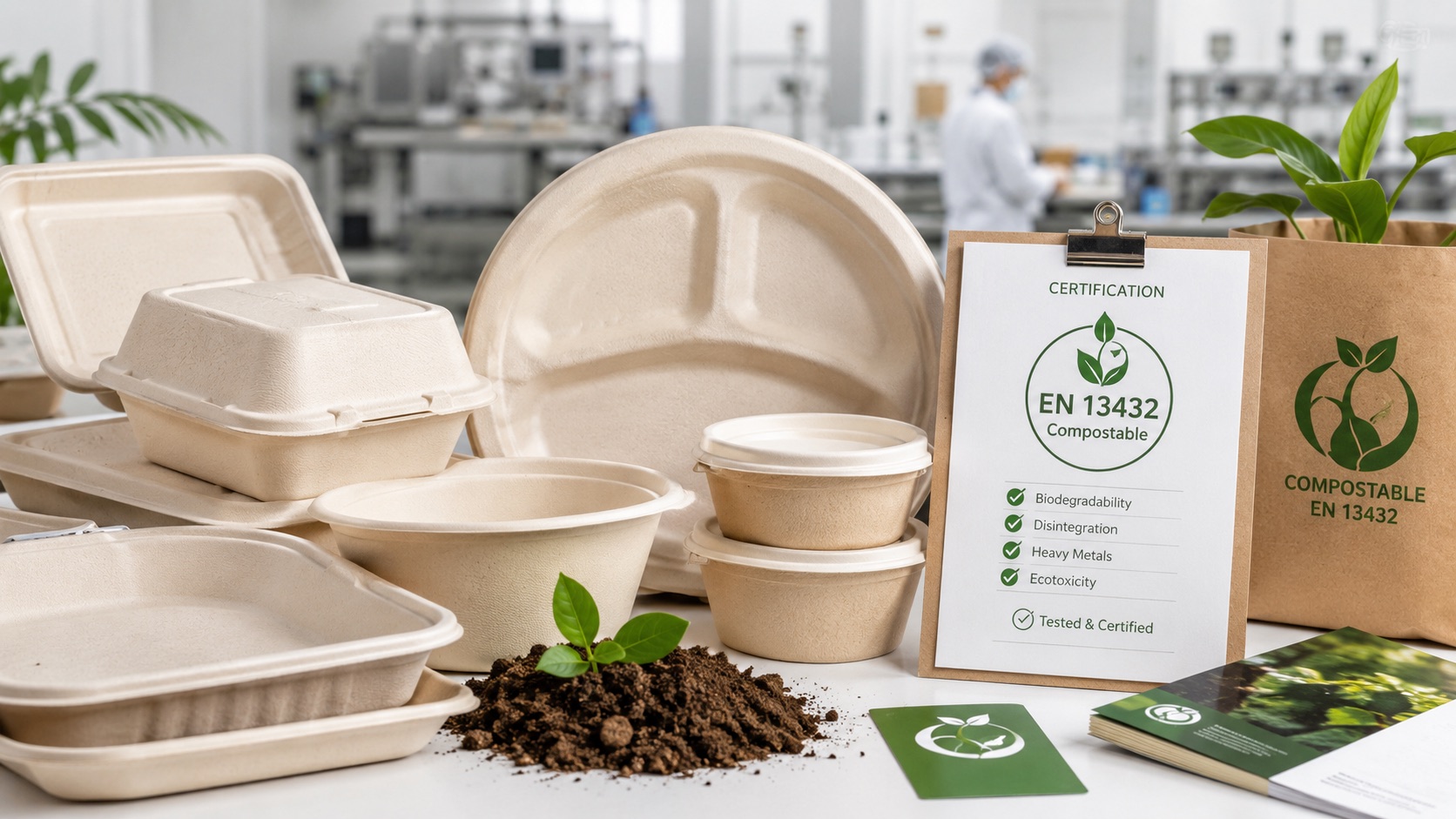
To meet EN 13432, packaging must demonstrate four properties under industrial composting conditions (typically 58°C and controlled moisture):
- Biodegradability: 90% conversion of carbon to CO₂ within 6 months
- Disintegration: ≤10% of material residue larger than 2mm after 12 weeks
- No negative effect on compost quality: Heavy metal content below specified limits; no toxicity to plant growth
- Chemical composition disclosure: Material composition documented; no banned substances
A compostable molded fiber product that meets all four criteria can be certified and marked with the “Seedling” logo, which is owned by European Bioplastics and issued under licence by certifiers including TÜV Austria and DIN CERTCO.
How testing works in practice
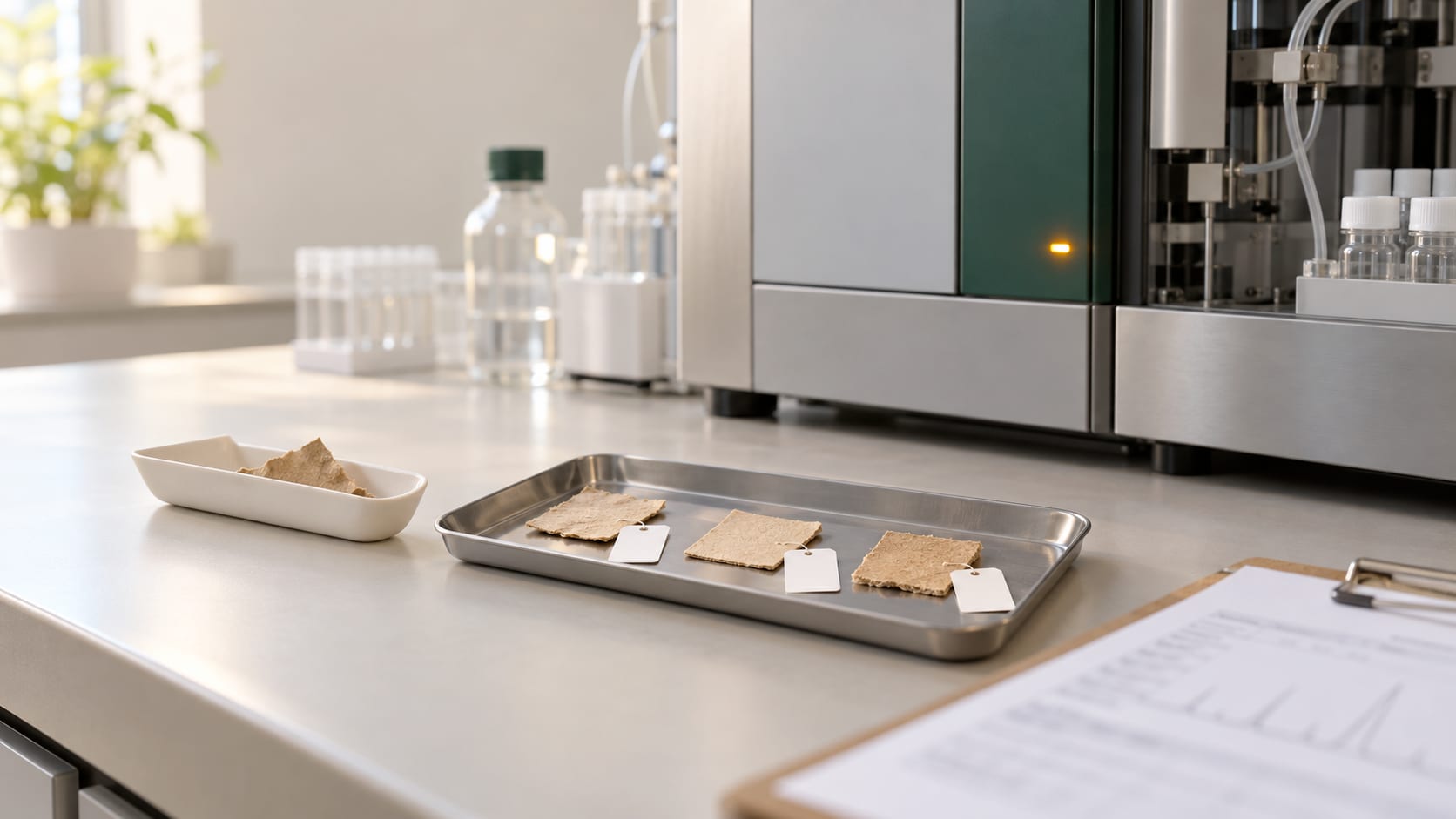
EN 13432 certification involves laboratory testing through accredited bodies, principally TÜV Austria’s OK compost INDUSTRIAL programme and DIN CERTCO. Tests typically run 4-6 months and cost €5,000-€15,000 per material formulation. Validity is set by the certifying body rather than by the standard: DIN CERTCO issues its industrial-compostability certifications for three years, and any certificate is void if the material formulation changes without re-certification. Always read the expiry date on the document in front of you rather than assuming a fixed term.
Critical caveats:
- Industrial vs home composting: EN 13432 covers industrial composting only (high temperature, controlled). Home compostable is a separate certification (NF T51-800 or TÜV Austria OK Home Compost).
- Material-specific certificates: Bagasse molded fiber, PLA, paper-PLA composites all require separate testing. A supplier with one EN 13432 certificate may not cover all their SKUs.
- Thickness limitations: Most certificates apply up to a maximum material thickness. Thicker products require separate testing.
Why EN 13432 matters in 2026
Two regulatory frameworks make EN 13432 a near-mandatory specification for foodservice packaging in 2026:
EU Packaging and Packaging Waste Regulation 2025
Article 9 of Regulation (EU) 2025/40 governs compostable packaging, and requires certain named formats, including permeable tea and coffee bags and soft single-serve units, to be industrially compostable from 12 February 2028. EN 13432 is the standard the European industrial compostability certification schemes are built on, but it is not named in the enacting articles of the Regulation, so packaging that does not meet it cannot be marketed as compostable in the EU. The separate 2030 deadline in the regulation concerns recyclability, not compostability, and the two are often conflated.
UK Plastic Packaging Tax
EN 13432 does not affect UK Plastic Packaging Tax liability, and misreading this is expensive. HMRC guidance states that plastics “include polymers which are: biodegradable, compostable, oxo-degradable”, so a certified compostable plastic such as PLA is taxed exactly as conventional plastic is. What sits outside the tax is non-plastic material, because “cellulose-based polymers that have not been chemically modified” are not treated as plastic. That is why uncoated bagasse fibre is out of scope while a PLA lining or a PET lid on the same order is not.
What to verify with suppliers
When evaluating an EN 13432 claim:
- Request the certificate, not just a logo: The Seedling logo is widely misused. The actual certificate from TÜV Austria or DIN CERTCO is the proof.
- Verify the certificate scope: Confirm the specific SKUs you’re buying are within the certified scope and thickness range.
- Check the expiry date: validity is set by the certifying body, not the standard, and DIN CERTCO issues its certifications for three years. An expired certificate is invalid for new market claims.
- Cross-check with the certifying body’s database: TÜV Austria maintains a publicly searchable database of certified products, so a reference number that does not appear there is a red flag.
- Confirm material composition has not changed: Certificates are voided by formulation changes the supplier did not re-certify.
EN 13432 vs ASTM D6400
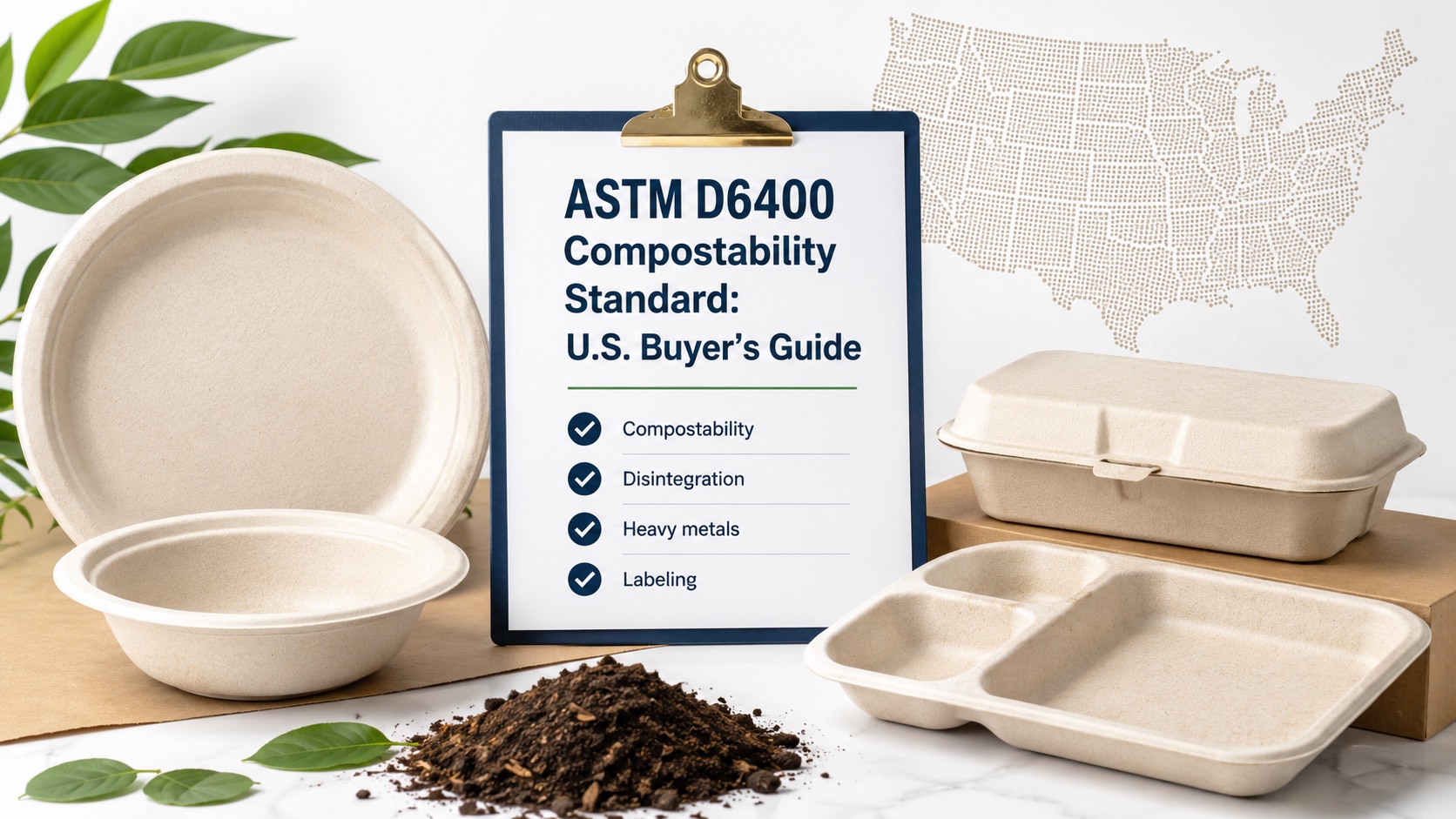
The U.S. equivalent of EN 13432 is ASTM D6400. The two standards are technically aligned (both require ~90% biodegradation under industrial composting) but operate on different administrative regimes. A product certified to EN 13432 typically also passes ASTM D6400 testing, but the certifications are issued separately by region-appropriate bodies.
For multi-market suppliers, buyers look for both EN 13432 (EU and UK) and ASTM D6400 (U.S.) compostability. Both sit alongside ASTM D6868 and IS/ISO 17088 in the side-by-side comparison of all four compostability standards. Ecofy holds an Intertek ASTM D6868 report, tested to the EN 13432 methods (ISO 14855 and ISO 16929), with full documentation on request.
Common pitfalls in EN 13432 claims
- “Biodegradable” ≠ “EN 13432 compostable”: Biodegradable is a vague term with no specific standard behind it. EN 13432 is specific and verifiable.
- “OK Compost” vs “OK Compost HOME”: The first is industrial composting (matches EN 13432). The second is home composting and is a different, stricter standard.
- Hybrid products: A bagasse bowl with a PET lid is partially compostable. The bagasse meets EN 13432; the PET does not. Marketing the entire product as compostable is non-compliant.
Ecofy’s EN 13432 position
Ecofy’s molded fiber bagasse plates, bowls, and compostable clamshell containers are tested to EN 13432 / ISO 14855 / ISO 16929 methods by Intertek, under ASTM D6868. PET lids on takeaway bowls are not compostable; they are recyclable through standard PET streams. We mark this distinction explicitly on product spec sheets and recommend customers do the same in retail labelling and ESG reporting.
Want guides like this in your Google results?
Add Ecofy as a preferred source. Google will surface our compliance standards and trade-data guides more often when you search packaging rules, including in AI Overviews. Takes one click and you can remove it any time.