EU PFAS Limits for Food-Contact Packaging, 12 August 2026
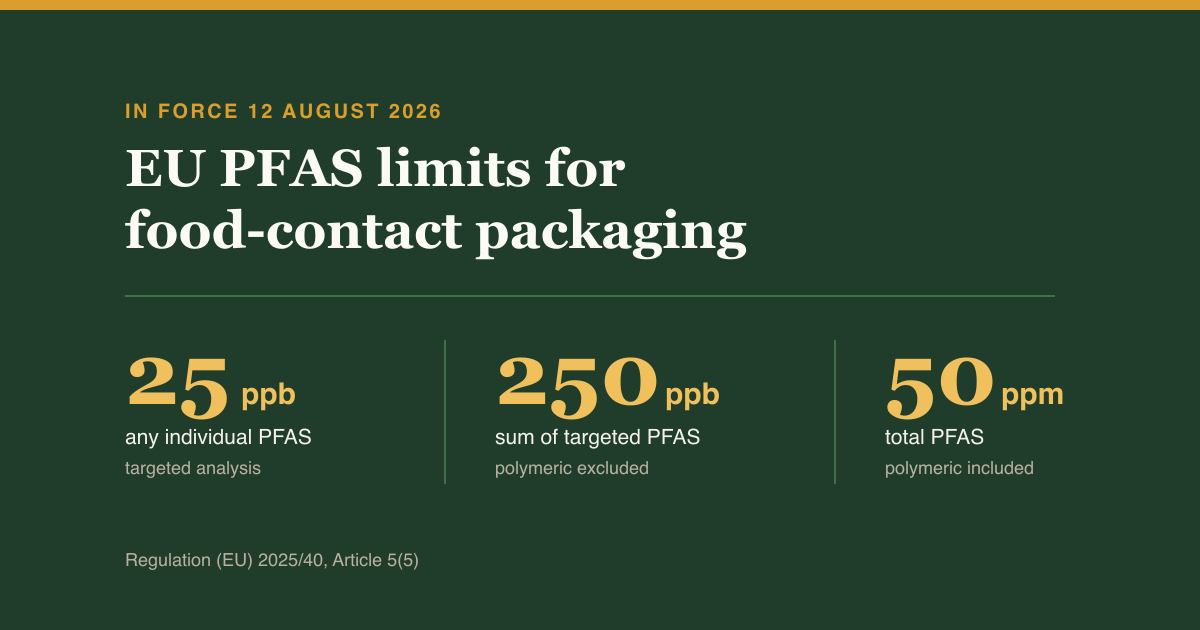
EU Regulation 2025/40 Article 5(5) now applies: 25 ppb individual PFAS, 250 ppb sum, 50 ppm total including polymeric. No transitional period.
On this page
Sourcing in bulk?
Tell us your products and quantity
We supply distributors and brands in 30+ countries, and reply with pricing, lead time and shipping.
The PFAS restrictions in Article 5(5) of the EU Packaging and Packaging Waste Regulation, Regulation (EU) 2025/40, took effect on 12 August 2026.
The three thresholds
Food-contact packaging cannot be placed on the EU market if it contains PFAS at or above any of these levels:
| Measure | Limit | Polymeric PFAS |
|---|---|---|
| Any individual PFAS, targeted analysis | 25 ppb | excluded from quantification |
| Sum of targeted PFAS | 250 ppb | excluded from quantification |
| Total PFAS | 50 ppm | included |
Two details are frequently misreported and both matter in practice.
The 50 ppm figure is total PFAS including polymeric PFAS, not total fluorine. Total fluorine is a screening measurement, and it is the basis of some US state limits, but it is not the EU threshold itself. Confusing the two produces the wrong test request.
The limits apply to concentration in the packaging, not migration into food. That is a different basis from most food-contact legislation, which is built around migration. It also means both intentionally and non-intentionally added PFAS are in scope, so carryover from raw materials or process aids counts.
No transitional period
There is no phase-in and no general stock-exhaustion allowance.
- Packaging already placed on the EU market before 12 August 2026 may remain on it.
- Packaging manufactured before that date but first placed on the market afterwards must comply.
For importers holding pre-deadline production, that second point is the operative one.
How compliance is tested
There is no harmonised EU methodology for PFAS in food-contact packaging. The Commission describes a stepwise approach:
Step 1: total fluorine screening
Measure total fluorine in the packaging. A result below 50 mg/kg indicates compliance and testing can stop there. Because the threshold is a ceiling on total PFAS, a total-fluorine result under it rules out an exceedance.
Step 2: separating organic from inorganic fluorine
If the screen does not clear it, pyrolysis GC/MS distinguishes organic fluorine from inorganic. Below 50 mg organic fluorine per kg indicates compliance.
Step 3: targeted and TOP analysis
If still unresolved, run targeted analysis, with degradation of precursors where applicable, against the 25 ppb and 250 ppb limits.
Because the PFAS group runs to somewhere between 12,000 and 18,000 known compounds, total fluorine has become the practical first-line screen rather than attempting to enumerate individual substances. Laboratories generally work to ISO/IEC 17025 accreditation, with methods including EN 14582 and ISO 21675.
Where the evidence has to sit
Article 5(6) requires that compliance with the PFAS and heavy-metal restrictions be demonstrated in the technical documentation for the packaging. Evidence is expected per packaging type, since material, supplier and layer composition all vary.
The related heavy-metals restriction sets a combined limit of 100 ppm by weight for lead, cadmium, mercury and hexavalent chromium.
Our full guide to the regulation, including scope, timelines and the other obligations it introduces, is on the EU Packaging and Packaging Waste Regulation page. Market-by-market rules, including how the EU position compares with US state limits, are tracked in our compliance checker, and the testing question is covered in more depth in our guide to PFAS-free bagasse tableware.
Documentation for EU shipments
Buyers shipping into the EU generally need the position evidenced rather than asserted. Ecofy (Parason Machinery Pvt. Ltd.) has manufactured moulded fibre tableware since 2020 under BRCGS Grade A certification, supplying distributors in 30+ countries. Our uncoated sugarcane bagasse range is PFAS-free with status verified by third-party testing, and we issue the supporting documentation per shipment. Request a quote or a sample set, state the destination market, and our export team will confirm what paperwork accompanies the order. Buyers supplying the European market can also see our EU and UK market pages for shipping routes and lead times.
Sources: Regulation (EU) 2025/40 of the European Parliament and of the Council on packaging and packaging waste, Article 5(5) and Article 5(6), full text on EUR-Lex. Threshold detail and the stepwise testing approach as reported by the Food Packaging Forum.
Want guides like this in your Google results?
Add Ecofy as a preferred source. Google will surface our compliance standards and trade-data guides more often when you search packaging rules, including in AI Overviews. Takes one click and you can remove it any time.