EU Packaging Regulation 2025 (PPWR): Buyer's Guide
PPWR explained for buyers: Article 5 PFAS limits in force, Article 6 recyclability grades, Article 7 recycled content, Article 9 compostable packaging, Article 25 format restrictions.
On this page
Sourcing in bulk?
Tell us your products and quantity
We supply distributors and brands in 30+ countries, and reply with pricing, lead time and shipping.
Short answer: Regulation (EU) 2025/40, the PPWR, entered into force on 11 February 2025 and applies generally from 12 August 2026. It replaces the 1994 directive and applies directly in all 27 member states. The PFAS limits in Article 5(5) are already in force. The recyclability, recycled-content, compostability and format-restriction obligations land later, between 2028 and 2038.
The EU Packaging and Packaging Waste Regulation (PPWR), formally Regulation (EU) 2025/40, replaced the 1994 Packaging and Packaging Waste Directive (94/62/EC). The shift from “directive” to “regulation” is the single most important structural detail: PPWR applies directly across all 27 EU member states without national transposition, so the definitions, thresholds and deadlines are the same in every market.
Every article and date below is cited to the regulation text. Where an obligation is tied to secondary legislation, that is stated, because several dates are expressed as “whichever is the latest”.
Why the regulation form matters
Under the previous directive, each member state transposed requirements differently, which created a multi-jurisdiction compliance burden for chains operating across the EU. PPWR narrows that variance:
- One rule book: the same definitions, thresholds and deadlines in every member state
- Direct enforcement: national authorities enforce the EU regulation itself, not transposed national law
- Single market entry: packaging compliant under PPWR is compliant across the EU
Member States retain some discretion, including on certain pre-2025 national restrictions under Article 25(2) and on requiring compostability for specific formats under Article 9(2).
Article 5: substances, and the PFAS limits already in force
This is the provision that binds today, and the one most relevant to a foodservice buyer sourcing now.
Article 5(5) provides that from 12 August 2026, food-contact packaging shall not be placed on the market if it contains per- and polyfluorinated alkyl substances at or above:
| Limit | Basis of measurement |
|---|---|
| 25 ppb | any individual PFAS, targeted analysis, polymeric PFAS excluded from quantification |
| 250 ppb | the sum of PFAS, targeted analysis, polymeric PFAS excluded from quantification |
| 50 ppm | PFAS including polymeric PFAS |
Where total fluorine exceeds 50 mg/kg, the supplier must on request provide proof of the quantity of fluorine measured as PFAS or non-PFAS content, so that the manufacturer or importer can complete the technical documentation required by Annex VII.
Article 5(4) separately caps the sum of lead, cadmium, mercury and hexavalent chromium at 100 mg/kg.
There is no grandfathering provision for stock manufactured before the date. The test is whether the packaging is placed on the EU market.
Article 6: recyclable packaging, in three stages
Article 6 is not a single 2030 cliff. It phases in against the recyclability performance grades in Table 3 of Annex II:
- From 1 January 2030, or 24 months from entry into force of the relevant delegated act, whichever is the latest: packaging shall not be placed on the market unless it is recyclable within grades A, B or C
- From 1 January 2035, or five years from entry into force of the relevant implementing act: the recycled-at-scale requirement applies
- From 1 January 2038: packaging shall not be placed on the market unless it is recyclable within grades A or B, so grade C ceases to be sufficient
Article 7: minimum recycled content in plastic packaging
The percentages differ by material and format, and the common summary of “30% by 2030” applies only to PET. By 1 January 2030, or three years from entry into force of the implementing act referred to in Article 7(8), whichever is the latest:
| Plastic packaging category | 2030 | 2040 |
|---|---|---|
| Contact-sensitive, PET as major component (excluding single-use beverage bottles) | 30% | 50% |
| Contact-sensitive, non-PET (excluding single-use beverage bottles) | 10% | 25% |
| Single-use plastic beverage bottles | 30% | 65% |
| All other plastic packaging | 35% | 65% |
Recycled content must be recovered from post-consumer plastic waste. A PET lid supplied with a fibre base is assessed as a plastic part on its own terms.
Article 9: compostable packaging, and the claim buyers get wrong
Article 9 does not create a general compostability route out of the recyclability requirement.
Article 9(1) is a derogation from Article 6(1), but only for the packaging specified in Article 3(1), point (1)(f), together with sticky labels affixed to fruit and vegetables. By 12 February 2028 those items must be compatible with industrial composting standards, and with home-composting standards where a Member State requires it.
Article 9(2) allows Member States, where they collect compostable material with bio-waste and have the treatment infrastructure, to require compostability for certain lightweight carrier bags and for formats they already required to be compostable.
Article 9(3) is the provision that matters most:
“By 12 February 2028, packaging other than that referred to in paragraphs 1 and 2, including packaging made of biodegradable plastic polymers and other biodegradable materials, shall be designed for material recycling in accordance with Article 6 without affecting the recyclability of other waste streams.”
So a compostability certificate is not a substitute for Article 6. Biodegradable and compostable plastics are expressly caught by the design-for-recycling requirement.
What this means for moulded fibre. Bagasse fibre satisfies Article 6 because fibre is recyclable in existing paper and board streams, with compostability as an additional property rather than an alternative to recyclability. That is a stronger position than a compostable plastic, which has to satisfy the same recycling design requirement without a fibre recycling stream to fall into.
Article 25: restrictions on certain packaging formats
Article 25(1) provides that from 1 January 2030, economic operators shall not place on the market packaging in the formats and for the uses listed in Annex V. The restricted list sits in Annex V rather than in the article, and PPWR also amends the Single-Use Plastics Directive (EU) 2019/904 through Article 67.
Two qualifications: Member States may maintain certain restrictions adopted before 1 January 2025 under Article 25(2), and may allow micro-enterprises to continue using some Annex V formats where it is demonstrably not technically feasible to avoid them, under Article 25(4).
Reuse and refill: Articles 29, 32 and 33
These are three different obligations and they are frequently merged into one:
- Article 29 sets the re-use targets, which apply to transport packaging, e-commerce packaging and beverages in the retail sector, not to takeaway foodservice packaging
- Article 32 sets the refill obligation for the takeaway sector, the requirement to allow customers to bring their own container
- Article 33 sets the re-use offer obligation for the takeaway sector
The European Commission’s own summary of the takeaway sequence is that the sector must offer customers the possibility of bringing their own containers by 2027, ensure a re-use offer by 2028, and “shall endeavour” to offer 10% of products in reusable packaging by 2030. That last one is a best-efforts obligation, not a binding target, and it is often reported as though it were mandatory.
Documentation buyers should request
- EU declaration of conformity under Article 39, referencing the applicable articles
- Annex VII technical documentation, which is where Article 5 substance compliance is evidenced
- PFAS test evidence against the Article 5(5) limits for any food-contact item
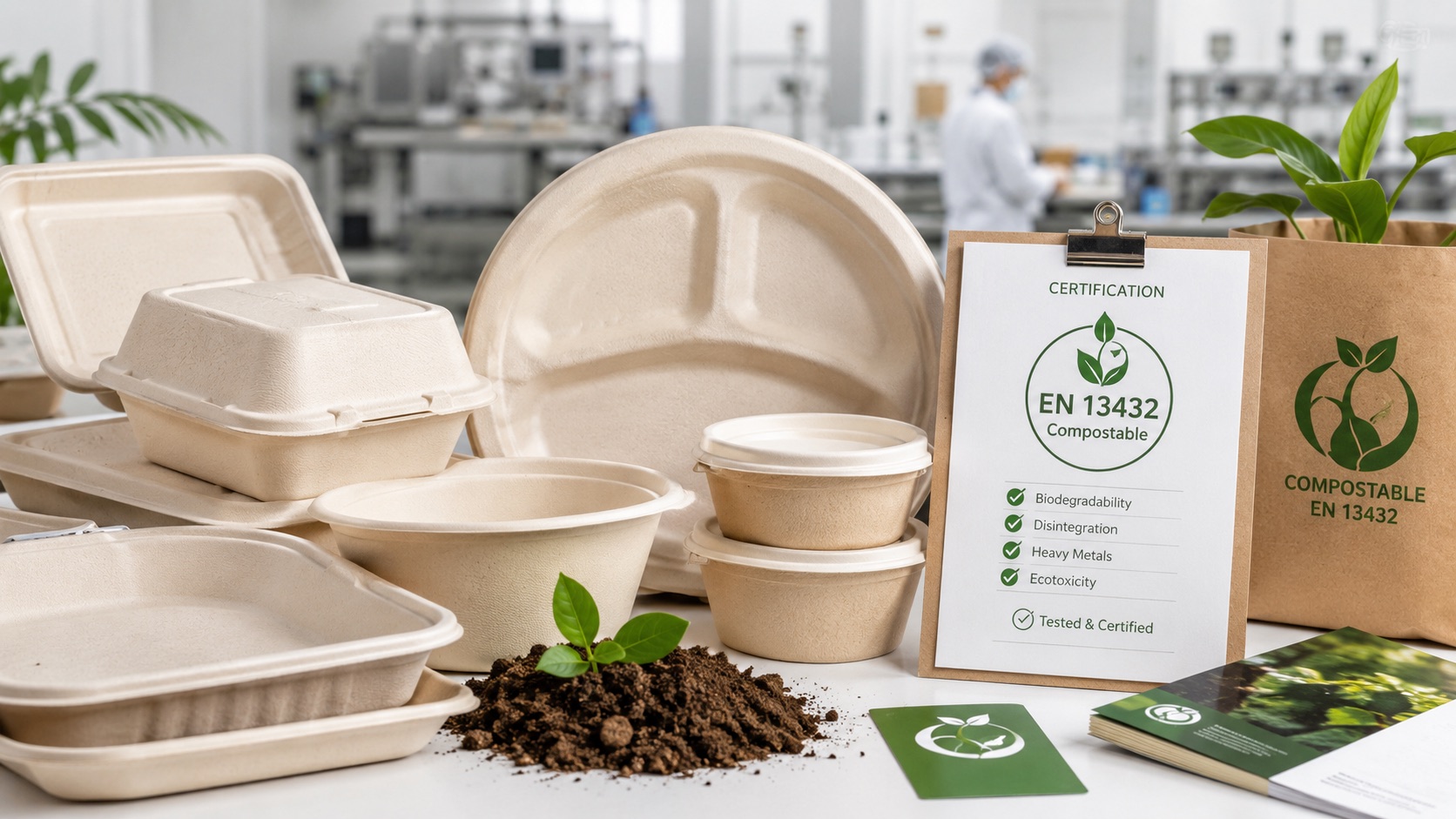
- Current EN 13432 certificate from an accredited body such as TÜV Austria or DIN CERTCO, where compostability is claimed. A certificate is issued against a named scope rather than to a company, so check it covers the item you are buying: what a compostability certificate actually covers
- Material composition declaration
- Recyclability statement for plastic components such as PET lids
Penalties
Article 68 requires Member States to lay down penalties for infringement. Penalty levels are therefore set nationally rather than by the regulation, and vary by member state, so confirm the applicable regime with your importer for the market you are shipping into.
Timeline summary
| Date | Requirement |
|---|---|
| 11 Feb 2025 | PPWR enters into force; replaces the 1994 Directive |
| 12 Aug 2026 | General application. Article 5(5) PFAS limits bite |
| 12 Feb 2028 | Article 9(1) compostability for specified items; Article 9(3) design-for-recycling for biodegradable packaging |
| 1 Jan 2030 | Article 6 recyclability grades A, B or C (or 24 months from the delegated act) |
| 1 Jan 2030 | Article 7 recycled-content minimums (or 3 years from the implementing act) |
| 1 Jan 2030 | Article 25 restrictions on Annex V formats |
| 1 Jan 2035 | Article 6 recycled-at-scale requirement |
| 1 Jan 2038 | Article 6 tightens to grades A or B only |
| 1 Jan 2040 | Article 7 higher recycled-content thresholds |
Dates expressed as “whichever is the latest” depend on secondary legislation and can move. Confirm against the current text before relying on a date commercially.
Ecofy and PPWR
Ecofy’s moulded fibre bagasse plates and bowls are tested to EN 13432 methods (via Intertek, under ASTM D6868), and fibre is recyclable in existing paper streams, which is the route to Article 6 compliance. PFAS test evidence against the Article 5(5) limits is available on request. Documentation pre-cleared for EU import: declarations of conformity, material composition declarations and recyclability statements are supplied with every shipment. Wholesale ordering is open to EU distributors and chains.
Sources. Regulation text: Regulation (EU) 2025/40 on EUR-Lex. Commission overview: European Commission, packaging and packaging waste. Compostability certification bodies: TÜV Austria OK compost INDUSTRIAL and DIN CERTCO industrial compostable products. Article and date references verified against the regulation text on 14 August 2026.
Want guides like this in your Google results?
Add Ecofy as a preferred source. Google will surface our compliance standards and trade-data guides more often when you search packaging rules, including in AI Overviews. Takes one click and you can remove it any time.