ASTM D6400 Compostability Standard: U.S. Buyer's Guide
ASTM D6400 explained. BPI certification, California SB 54, state plastic-ban references, what to verify with suppliers.
On this page
Sourcing in bulk?
Tell us your products and quantity
We supply distributors and brands in 30+ countries, and reply with pricing, lead time and shipping.
Short answer: ASTM D6400 is the US standard for compostability in industrial facilities. It is the reference standard behind BPI certification and is named in California law, in the Public Resources Code rather than in SB 54. For buyers the document that matters is a test report against D6400 conditions, not a supplier claim.
ASTM D6400 is the United States standard for plastics designed to be aerobically composted in municipal or industrial facilities. Published by ASTM International, it is the U.S. counterpart to Europe’s EN 13432 and the reference standard behind the Biodegradable Products Institute (BPI) certification mark. It is widely referenced in state packaging and compostability rules. Where the standard is named, it is sometimes in the statute itself: California names D6400 and D6868 directly in the Public Resources Code. Elsewhere it sits in implementing regulations, so the requirement should be confirmed state by state.
What ASTM D6400 requires
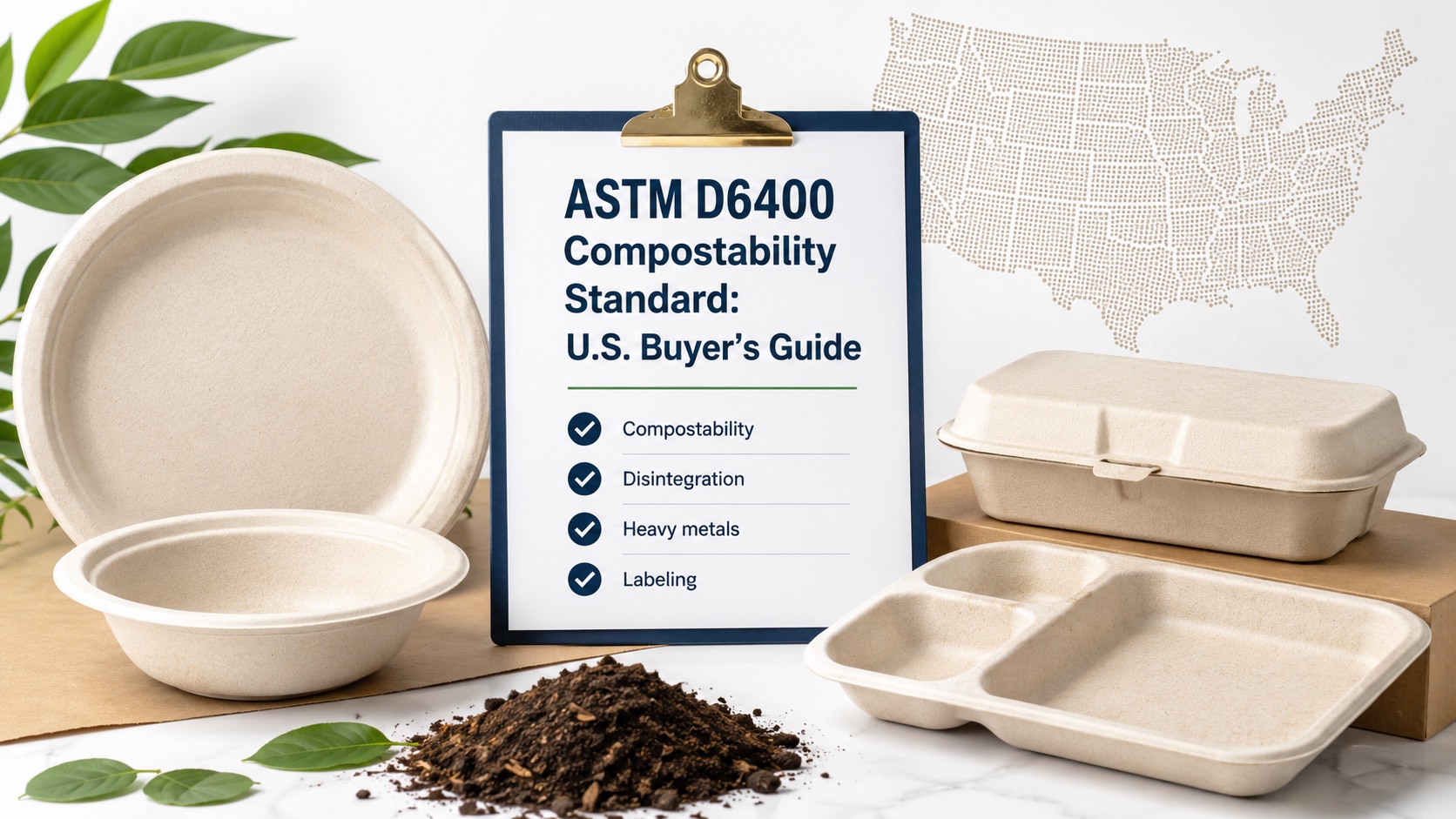
To meet ASTM D6400, packaging must satisfy four criteria under industrial composting conditions:
- Biodegradation: ≥90% conversion of organic carbon to CO₂ within 180 days under controlled composting conditions
- Disintegration: ≥90% of material passes a 2mm sieve at 84 days (12 weeks)
- Eco-toxicity: biodegradation by-products must not negatively affect seed germination or plant growth in the resulting compost
- Heavy metals: below defined limits for mercury, lead, cadmium and chromium
BPI adds a requirement the standards themselves do not. For BPI certification, BPI requires the total fluorine content of the finished product not to exceed 100 ppm. That is a PFAS screen in practice, and it means a valid BPI certificate carries fluorine evidence that an ASTM test report alone does not. Worth asking for explicitly. California’s AB 1200 sets 100 ppm at the same number but measures a different thing, total organic fluorine, so the two are not interchangeable evidence.
BPI certification (the U.S. equivalent of TÜV’s Seedling)
The Biodegradable Products Institute (BPI) is the primary certifying body for ASTM D6400 in the U.S. and Canada. BPI certification involves third-party laboratory testing and ongoing surveillance audits. BPI-certified products carry the BPI logo, which is the most recognized compostability mark in the U.S. foodservice market.
Note: BPI does not perform the testing itself. Testing is conducted by accredited labs (Eden Research Lab, Organic Waste Systems, others). BPI reviews the lab data, issues the certification, and licenses the use of its mark.
Where ASTM D6400 is required
California
Two separate instruments are usually collapsed into one here, and it is worth keeping them apart.
The compostable labelling rule. The word “ASTM” does not appear in SB 54. The provisions that name the standard are in the California Public Resources Code, Chapter 5.7, which dates from SB 567 (Stats. 2011, Ch. 594) and was amended by AB 1201 (Stats. 2021, Ch. 504); section 42357 was further amended by SB 1046 (Stats. 2022, Ch. 991). Section 42356(b)(1) defines the ASTM standard specification as D6400 or D6868 as published in 2019, and section 42357 prohibits selling a product in California labelled compostable or home compostable unless it meets that specification, or holds OK compost HOME certification where applicable. Where ASTM publishes a revision, section 42356.1(a) requires CalRecycle to review it but leaves adoption to its discretion, so the 2019 editions stand unless and until CalRecycle adopts a later one.
Section 42356.1(d) matters to fibre buyers: fibre products demonstrated not to incorporate any plastics or polymers, “including, but not limited to, through lamination, extrusion, or mixing”, are not required to comply with an ASTM standard specification under that chapter.
SB 54. Separately, SB 54 requires single-use packaging and plastic foodware sold in California to be recyclable or compostable by 2032. BPI certification is the mark most commonly relied on in practice.
The rulemaking had a difficult history worth knowing, because dates published before 2026 are often stale: the Governor declined to adopt CalRecycle’s initial draft regulations in March 2025, the process was restarted, and a revised draft was withdrawn in January 2026. The permanent regulations were approved by the Office of Administrative Law on 1 May 2026 and became effective on filing. Producers had to enroll by 1 June 2026, via the Circular Action Alliance, as an independent reporting entity with CalRecycle, or through the small-producer exemption. Full program implementation is scheduled for January 2027 (CalRecycle).
State plastic-ban legislation
Several states run packaging, organics or foam legislation that bears on compostable foodware. The named schemes below are verifiable; whether each one references ASTM D6400 specifically varies, and the implementing rules rather than the statute usually carry the technical standard, so confirm the current requirement for your destination state rather than assuming:
- California: SB 54 (2022), the Plastic Pollution Prevention and Packaging Producer Responsibility Act
- Oregon: SB 582 (2021), the Plastic Pollution and Recycling Modernization Act, effective 1 January 2022 with recycling program changes from July 2025
- Washington: HB 1799 (2022), organics management
- New York: expanded polystyrene foam container ban, in force from 1 January 2022
- Connecticut, Maine, Vermont, Maryland, New Jersey: various foam and packaging measures on their own timelines
Municipal composting programs and commercial composters
Cities running organics-collection programs, and the commercial composters that serve them, commonly set their own acceptance criteria, and BPI certification is the mark most often asked for. Acceptance policies are set facility by facility rather than nationally, and several large composters have narrowed or withdrawn acceptance of compostable foodware entirely in recent years, so this cannot be treated as a uniform rule.
The practical consequence for a buyer is that a product can meet ASTM D6868 and still be refused by a specific facility. Confirm acceptance with the composter serving your destination market rather than assuming a certificate is sufficient.
Ecofy’s bagasse plates and molded fiber trays are tested to ASTM D6868 through Intertek.
What to verify with suppliers
- Request the BPI certificate, not just the logo: The BPI logo is widely misused. The actual certificate is the proof.
- Verify SKU scope: Confirm the specific SKUs you’re buying are within the certified scope.
- Check expiry: BPI certificates have validity periods; confirm current status.
- Cross-reference BPI’s database: BPI maintains a publicly searchable database of certified products at bpiworld.org.
- Confirm material composition has not changed: Reformulations void existing certifications.
ASTM D6400 vs EN 13432
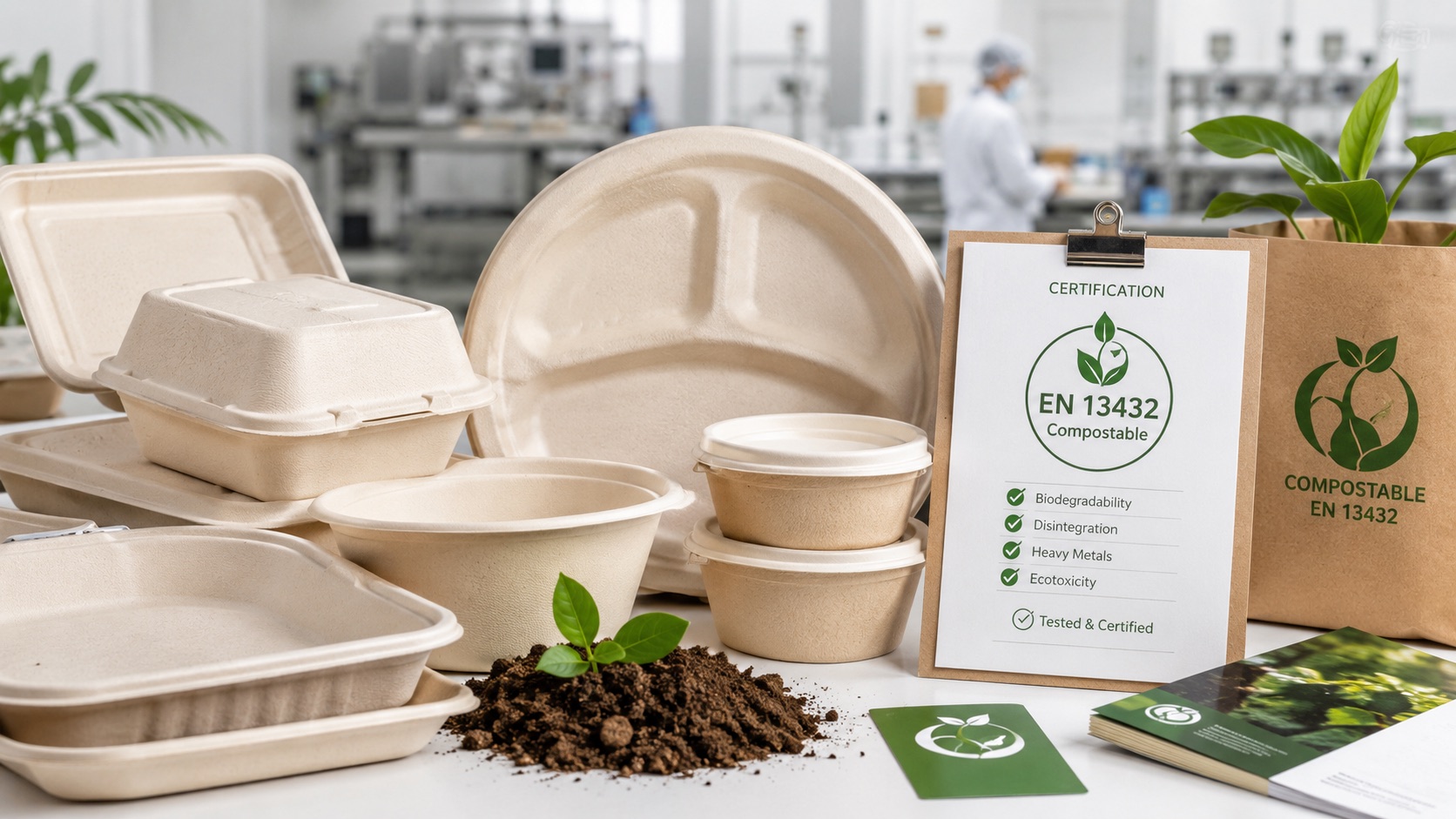
The two standards are closely aligned, and the practical differences are smaller than most comparisons suggest. Both require roughly 90% biodegradation under industrial composting conditions, both test disintegration on the same 84-day / 12-week basis, and both prohibit eco-toxic compost residue.
What actually differs:
- Certifying bodies: BPI in the U.S. and Canada; TÜV Austria and DIN CERTCO in Europe. This is the difference that matters commercially, because buyers and composters recognise different marks
- Heavy metal limits: the permitted concentrations are set differently between the two standards, so a pass under one is not automatically a pass under the other
- Fluorine: BPI applies a 100 ppm total-fluorine cap as a certification condition. EN 13432 itself does not
Biodegradation timeframes are often listed as a difference (180 days versus six months) but those are effectively the same period, so do not treat that as a distinguishing factor.
For multi-market suppliers, holding both BPI (ASTM D6400, in conjunction with D6868 or D8410 depending on the item) and TÜV Austria OK compost INDUSTRIAL (EN 13432) is the standard position.
Which ASTM specification applies depends on the item, not the material family. ASTM D8410-22 covers unlined cellulosic fibre products including moulded fibre, and excludes items with a thermoplastic laminated or extruded onto the substrate. ASTM D6868 covers exactly those lined items. The wider picture, including IS/ISO 17088 for India, is set out in how industrial and home compostable differ, and how the four standards compare.
Common pitfalls
- “Biodegradable” without ASTM D6400: Federal Trade Commission Green Guides classify “biodegradable” as misleading without specific testing evidence. ASTM D6400 is the recognized proof.
- “Home compostable” claims: ASTM D6400 covers industrial composting only. Home composting is verified by separate schemes such as TUV Austria OK Compost HOME or AS 5810, not by ASTM D6400. ASTM D6868 also covers industrial composting (of paper and fibre items with plastic coatings or additives), which is why molded bagasse is often tested to it; it is not a home-composting standard.
- Hybrid products: a bagasse bowl with a PET lid has a fibre base tested to ASTM D6868; the PET lid is not compostable at all. Marketing the whole unit as compostable is a misleading claim.
Ecofy’s ASTM D6400 position
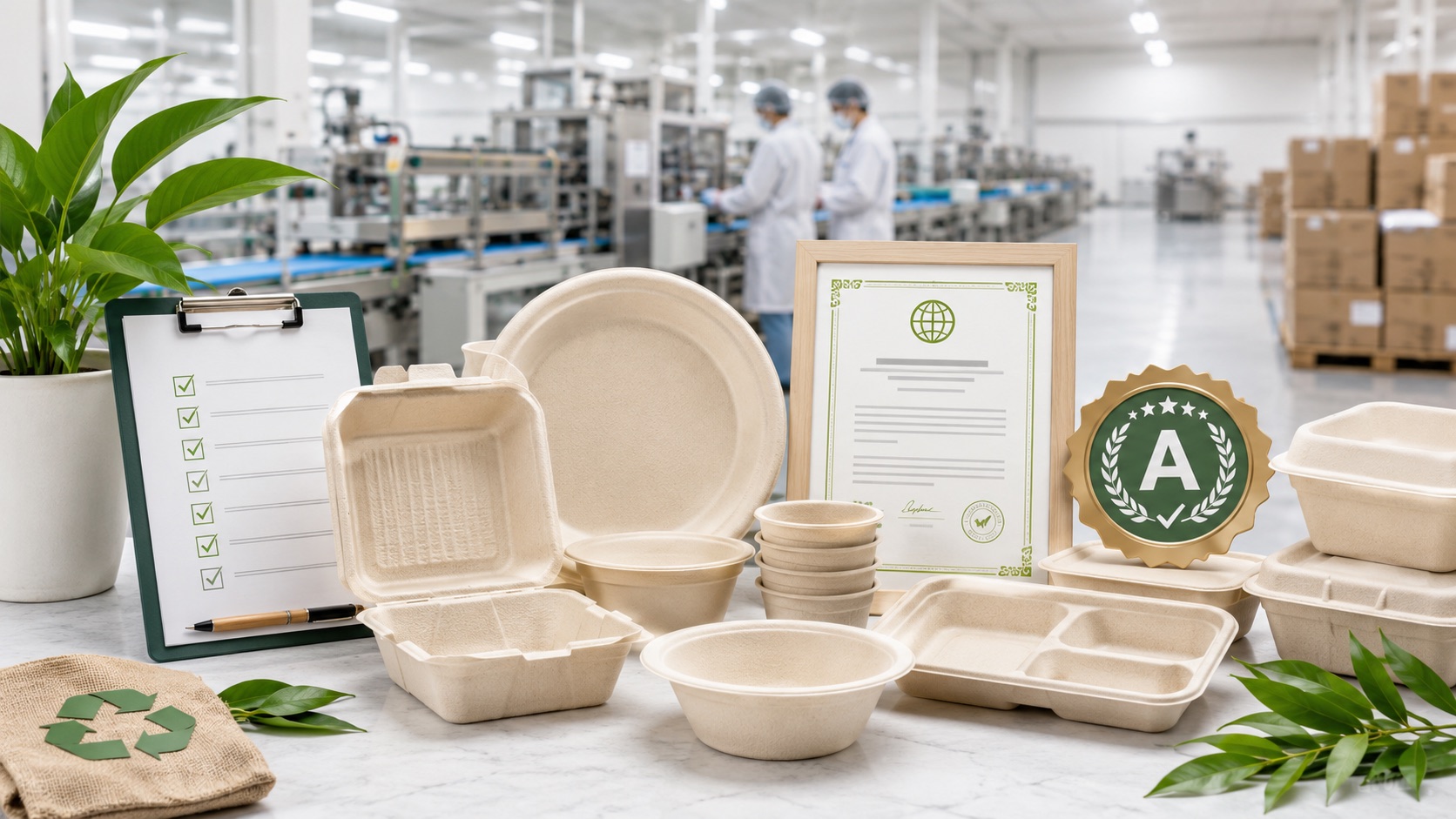
Ecofy’s molded fiber bagasse ASTM D6868 tested bowls and bagasse clamshell containers are tested to ASTM D6868 through Intertek, the molded-fiber counterpart to ASTM D6400. PET lids on takeaway bowls are not compostable; they are recyclable through standard PET streams. We mark this distinction explicitly on product spec sheets and recommend customers do the same in retail labeling and customer-facing communications.
Sources. Certification criteria: BPI, ASTM compostability standards and the BPI certified products database. California: CalRecycle, SB 54 permanent regulations. Oregon: Oregon DEQ, Plastic Pollution and Recycling Modernization Act. ASTM publishes D6400 and D6868 behind a paywall, so the criteria above are cited to BPI as the certifying body rather than to the standards documents. Verified 14 August 2026.
Want guides like this in your Google results?
Add Ecofy as a preferred source. Google will surface our compliance standards and trade-data guides more often when you search packaging rules, including in AI Overviews. Takes one click and you can remove it any time.