FSSAI Packaging and Labelling Regulations 2026
FSSAI packaging and labelling rules 2026: the packaging amendment in force since 10 August 2026, the labelling changes due 1 July 2027, and what buyers check.
On this page
Sourcing in bulk?
Tell us your products and quantity
We supply distributors and brands in 30+ countries, and reply with pricing, lead time and shipping.
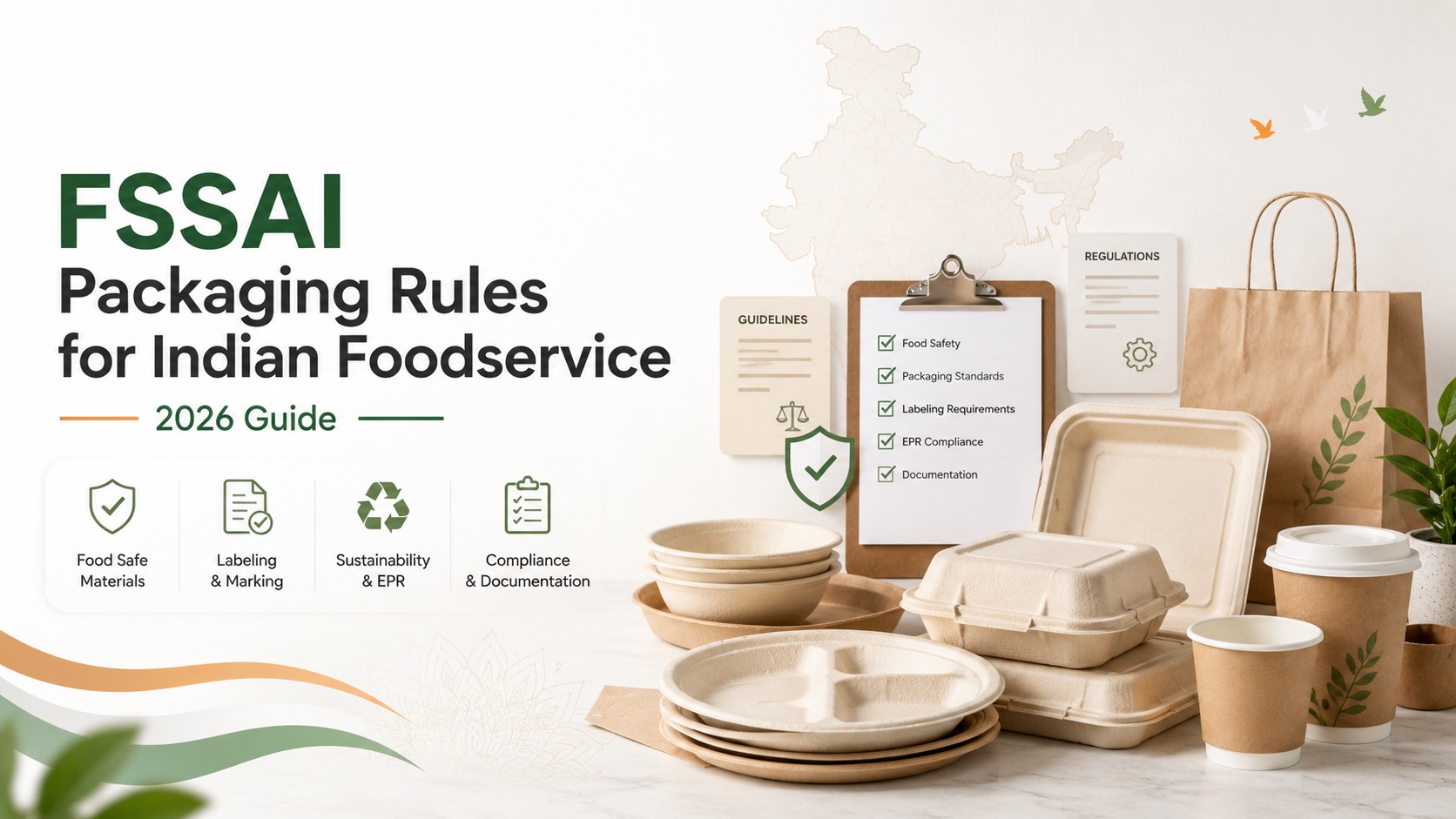
Short answer: FSSAI is India’s food safety regulator, and its packaging rules define what may be used in foodservice and FMCG. The packaging rules and regulations in India run across two instruments, the Food Safety and Standards (Packaging) Regulations, 2018 and the Labelling and Display Regulations, 2020, and these food packaging regulations operate alongside India’s single-use plastic restrictions rather than replacing them.
The Food Safety and Standards Authority of India (FSSAI) is the apex regulator for food safety in India. FSSAI’s packaging rules, particularly the 2018 Food Safety and Standards (Packaging) Regulations and subsequent amendments, define what packaging is permitted in foodservice and FMCG operations across India. The FSSAI Packaging First Amendment Regulations, 2025 (28 March 2025) introduced approved recycled PET (rPET) for food contact, A further amendment, notified on 7 August 2026 and in force since 10 August 2026, made pan masala the first food category in India required to be packed without plastic. A separate draft issued on 13 October 2025 would restrict PFAS and bisphenol A (BPA) in food-contact materials, and is not yet law.
The current FSSAI framework
FSSAI’s packaging regulations operate alongside three other major frameworks:
- Plastic Waste Management Rules 2016 (last amended by G.S.R. 237(E) of 31 March 2026, which added recycled-content and reuse targets): covers plastic-specific requirements
- Single-Use Plastic Ban 2022 (extended 2024): prohibits identified SUP categories
- Extended Producer Responsibility (EPR) Rules: mandates collection and recycling for plastic packaging
For foodservice operators, FSSAI compliance covers:
- Material composition and food-contact safety
- Migration limits (substances that may transfer from packaging to food)
- Labelling requirements
- Recyclability and disposal markings
What is now law, and what is still draft
Two different instruments carry the name Food Safety and Standards (Packaging) Amendment Regulations, 2026. One is in force. One is not. Separate them before you accept any supplier’s compliance claim built on “the 2026 amendment”.
In force since 10 August 2026: the pan masala amendment
FSSAI notified the Food Safety and Standards (Packaging) Amendment Regulations, 2026 on 7 August 2026 under F. No. RCD-09002/1/2026-Regulatory-FSSAI. They were published in the Gazette of India, Extraordinary, Part III, Section 4, No. 489 of 10 August 2026 (gazette reference CG-DL-E-10082026-275349) and came into force on that date of publication. The draft had gone out on 28 April 2026 with a sixty-day comment window.
The amendment inserts a new Serial Number 11, Pan Masala, into Schedule IV of the 2018 Packaging Regulations, the schedule that lists suggestive packaging materials by food category. The permitted materials are:
- Paper, paperboard, cellulose or other naturally derived materials. The material must be free from any plastic, including polyethylene, polypropylene, polyester and polyvinyl chloride (PVC), free from any synthetic polymers, co-polymers or laminates, and free from aluminium foil or metallised layers.
- Tin or glass containers.
- Clauses (f) and (i) of sub-rule (1) of rule 4 of the Plastic Waste Management Rules, 2016 apply in addition.
This does not reach foodservice tableware, and nothing about bagasse plates, bowls or clamshells changes because of it. It matters for two other reasons. It is the first time Indian packaging law has named a single food category and excluded plastic from it outright, which tells you the direction of travel. And when a supplier document cites “the FSS (Packaging) Amendment Regulations, 2026”, this is now usually the instrument being cited, not the draft below.
The wording also gives procurement a sharper test than “is it paper”. A fibre or paper pack carrying a polymer liner, a laminate or a metallised layer does not qualify under this entry. The question to put to a supplier is whether they can evidence that no polymer layer, laminate or foil is present, which is a specification and testing question rather than a material-name question.
As of 9 October 2026 FSSAI had not yet added this amendment to its own packaging amendments index, which still listed three amendments ending at 28 March 2025. The gazette is the operative record, not the index.
Still a draft: the definitions amendment
A separate draft, gazetted on 26 February 2026 (CG-DL-E-26022026-270529) and posted for public comment on 11 March 2026, proposes to amend the same 2018 regulations by adding six defined terms. They include a statutory definition of food contact material (FCM), which would reach tableware and kitchenware rather than packaging alone, and, for the first time in Indian packaging law, non-intentionally added substances (NIAS), alongside definitions covering modified atmosphere and aseptic packaging. Comments closed on 10 May 2026. The draft gazette notification is published on the FSSAI site.
This one is not in force. Any supplier presenting the definitions draft as a current requirement is ahead of the law.
It is worth watching rather than acting on. If NIAS becomes an explicit concept in Indian packaging law, the question a buyer asks a supplier shifts from “is the material permitted” to “what can you evidence about substances that were never deliberately added”, which is a documentation question rather than a material one.
The PFAS and BPA draft of 13 October 2025 sits in the same position: proposed, consulted on, not law.
What FSSAI permits for foodservice
Compliant foodservice packaging materials in India:
- Bagasse and other agro-fibre molded products: explicitly permitted, and outside the scope of plastic EPR registration because they contain no plastic
- Paper and paperboard: permitted with food-contact certification
- Glass: permitted
- Aluminium: permitted with food-contact certification
- Compliant plastics: only specific polymers (PET, PP, HDPE, LDPE) with specific food-contact grades; many plastic categories now banned under SUP rules
What’s banned under the SUP framework
The Single-Use Plastic Ban (effective July 2022, extended 2024) prohibits:
- Plastic stirrers, cutlery, plates, glasses
- Polystyrene foam containers
- Plastic flags, balloons, candy sticks
- Wrapping films around sweet boxes, invitation cards, cigarette packs
- Plastic banners less than 100 microns
- PVC banners less than 100 microns
For foodservice specifically, this means polystyrene clamshells (still common in 2022) are now non-compliant. Compostable replacements must also conform to IS/ISO 17088:2021 under the Plastic Waste Management Rules. Replacement options include bagasse molded fiber clamshells and compostable takeaway containers, paper-board (PFAS-free), and aluminium. For a format-by-format breakdown, see bagasse vs polystyrene foam.
Packaging and labelling are two separate regulations
Buyers often search for “FSSAI packaging and labelling regulations” as though they were one instrument. They are not, and the distinction matters when you are deciding which documents to ask for.
Packaging is governed by the Food Safety and Standards (Packaging) Regulations, 2018, which set material requirements and migration limits for anything in contact with food.
Labelling is governed by the separate Food Safety and Standards (Labelling and Display) Regulations, 2020. These bind the food business that labels the food. They do not impose label requirements on the manufacturer of empty tableware, which is a point of regular confusion when buyers ask a packaging supplier for “label compliance”.
What changes on 1 July 2027
FSSAI notified the Food Safety and Standards (Labelling and Display) First Amendment Regulations, 2026 on 24 March 2026 under F. No. STD/SP-08/A1.2022/N-01. Regulation 1(2) of the amendment states that they come into force on 1 July 2027, so nothing changes today, but the lead time matters if you commission printed packaging.
The amendment rewrites Regulation 10, which governs non-retail containers, and that is the part relevant to foodservice, institutional and bulk supply.
Five mandatory particulars must appear on the container or on a label pasted to it: name of the food; FSSAI logo and licence number; date marking and storage instructions where required for the safety or integrity of the product; lot, batch or code number; and the name and address of the manufacturer or packer, including country of origin for imported packages.
Three further particulars may sit in the accompanying documents instead of on the label: list of ingredients, the veg or non-veg declaration, and net quantity. Where they do, they must remain traceable to the food in the container.
Two reliefs that matter in practice. If a non-retail container holds multiple types of food, the mandatory information must be given for every type inside. But where the pre-packaged foods within the container already carry all of the Regulation 10(1) information on their own labels, the outer container does not need to repeat it. And for a transport unit that cannot carry a label at all, the information may travel in accompanying documents or by other appropriate means, including electronically between food businesses, provided it stays traceable.
Explicit identification. Every non-retail package must be clearly identifiable as such. Where it is not, it must carry a statement to that effect, and the regulation gives “NON-RETAIL CONTAINER” and “NON-RETAIL CONTAINER - NOT FOR DIRECT SALE TO CONSUMER” as examples, or any other mark showing it is not for direct sale to a consumer.
Legibility and tamper-evidence. A new sub-regulation requires the information to be clear, prominent, readily legible and applied so that tampering with it would be evident, and to sit in a prominent position that is readily accessible under normal handling.
Separately, the amendment inserts Regulation 8(1B), which allows the notified FSSAI logos to be omitted where the surface area of the package is not more than 100 square centimetres, though they must still appear on the multi-unit pack. That is the provision behind the loose talk about “relaxed rules for small packs”, and the threshold is specific.
One point of confusion worth settling: these duties bind the food business that labels the food, not the manufacturer of empty tableware. If you ask a bagasse supplier for “label compliance”, you are asking the wrong party. What you can ask them for is documentation that your own labelling will rest on.
The practical point for procurement: artwork and print runs have lead times measured in months. If you are specifying printed packaging now for delivery into 2027, the label specification you sign off should anticipate the July 2027 position rather than the current one.
Where to find the official FSSAI documents
Many searches for these rules are really searches for the PDF, and FSSAI spreads them across several pages. These are the current locations, checked on 9 October 2026.
| Document | Date | Where |
|---|---|---|
| Food Safety and Standards (Packaging) Regulations, 2018 | notified 24 December 2018 | gazette PDF |
| Packaging compendium, version V | 2 April 2025 | compendium PDF |
| Packaging amendments index | three listed, to 28 March 2025 | FSSAI index |
| FSS (Packaging) Amendment Regulations, 2026 (pan masala) | notified 7 August, gazetted 10 August 2026 | Gazette of India Extraordinary Pt III Sec 4 No. 489, CG-DL-E-10082026-275349 |
| Food Safety and Standards (Labelling and Display) Regulations, 2020 | 14 December 2020 | gazette PDF |
| Labelling and display compendium, version VIII | 9 September 2025 | compendium PDF |
| FSS (Labelling and Display) First Amendment Regulations, 2026 | 24 March 2026 | amendment no. 5 PDF |
A compendium is FSSAI’s consolidated text with every amendment folded in, and it is usually what a buyer actually wants rather than the original gazette plus a stack of separate amendments. Note that a compendium is only current to its version date, so for anything notified after it you still need the gazette. New notifications appear on the FSSAI notifications list, and drafts open for comment sit in the notice for comments archive.
EPR registration and brand-owner liability
EPR rules require brand owners (the entity whose name appears on the consumer-facing packaging) to:
- Register with the Central Pollution Control Board (CPCB)
- Submit annual EPR action plans
- Achieve specified collection and recycling targets
- Pay fees if targets are missed
For QSR chains, hotel groups, and FMCG brands operating in India, this creates a significant administrative overhead for plastic packaging.
Bagasse and other compostable agro-fibre packaging sits outside the scope of plastic EPR registration, because India’s plastic waste EPR framework applies to plastic packaging. There is no exemption to claim and no evidence to file, which materially simplifies the compliance overhead.
What FSSAI compliance documentation looks like
A compliant foodservice packaging supplier should provide:
- FSSAI registration certificate (covering manufacturing or import facility)
- Material composition declaration with food-contact grade certification
- Migration test results from accredited Indian labs (CIPET, SGS India, Intertek India)
- Heavy metals and toxic substances declaration
- EPR registration (for plastic-content packaging only, exempt for bagasse)
What buyers should verify
When evaluating an Indian foodservice packaging supplier:
- Confirm FSSAI registration status: verifiable through fssai.gov.in
- Request migration test reports dated within the last 12 months
- Check that test reports cover the specific SKUs ordered (different products require different tests)
- For plastic packaging: verify EPR registration and current collection targets
- For compostable packaging: confirm material composition matches the food-contact standard
Common pitfalls
- “FSSAI registered” vs “FSSAI licensed”: Small operators register; larger operators license. Confirm the right one for the supplier’s scale.
- Expired migration test reports: Reports older than 12 months should be re-issued before procurement signoff.
- Ambiguous material declarations: “Bagasse-based” without specific composition disclosure can hide PFAS coatings or other additives.
Ecofy’s FSSAI position
Ecofy operates with current FSSAI registration covering all bagasse molded fiber SKUs manufactured at the Chhatrapati Sambhajinagar (Aurangabad) facility. Migration test reports from CIPET, SGS, and Intertek are issued annually and made available to buyers on request. PFAS-free declaration is included with all standard documentation.
Ecofy’s compostable bagasse plates and bagasse bowls sit outside the scope of plastic EPR registration, simplifying compliance overhead for QSR chains, hotel groups, and FMCG brands operating in India. Bulk buyers can order at wholesale volumes.
Want guides like this in your Google results?
Add Ecofy as a preferred source. Google will surface our compliance standards and trade-data guides more often when you search packaging rules, including in AI Overviews. Takes one click and you can remove it any time.