UAE Single-Use Plastic Ban 2026: Foodservice Guide
UAE single-use plastic ban for foodservice buyers: what is banned, the Dubai and Abu Dhabi timeline, fines, and permitted alternatives.
On this page
Sourcing in bulk?
Tell us your products and quantity
We supply distributors and brands in 30+ countries, and reply with pricing, lead time and shipping.
Short answer: The UAE has phased out single-use plastic and polystyrene foam foodservice products. As of 2026 restrictions cover plates, cutlery, cups, straws, stirrers and foam containers across Dubai, Abu Dhabi and the wider market. Importers should confirm which emirate applies, the current phase, and what documentation proves a compliant alternative.
The UAE has phased out single-use plastic and polystyrene foam foodservice products, and as of 2026 the restrictions cover plates, cutlery, cups, straws, stirrers and foam containers across Dubai, Abu Dhabi and the wider market. This is a regulation-led buyer guide for distributors, importers, caterers and packaging buyers: what is restricted, the timeline, the fines, which alternatives are permitted, and what to check before you source.
What does the UAE single-use plastic ban cover?
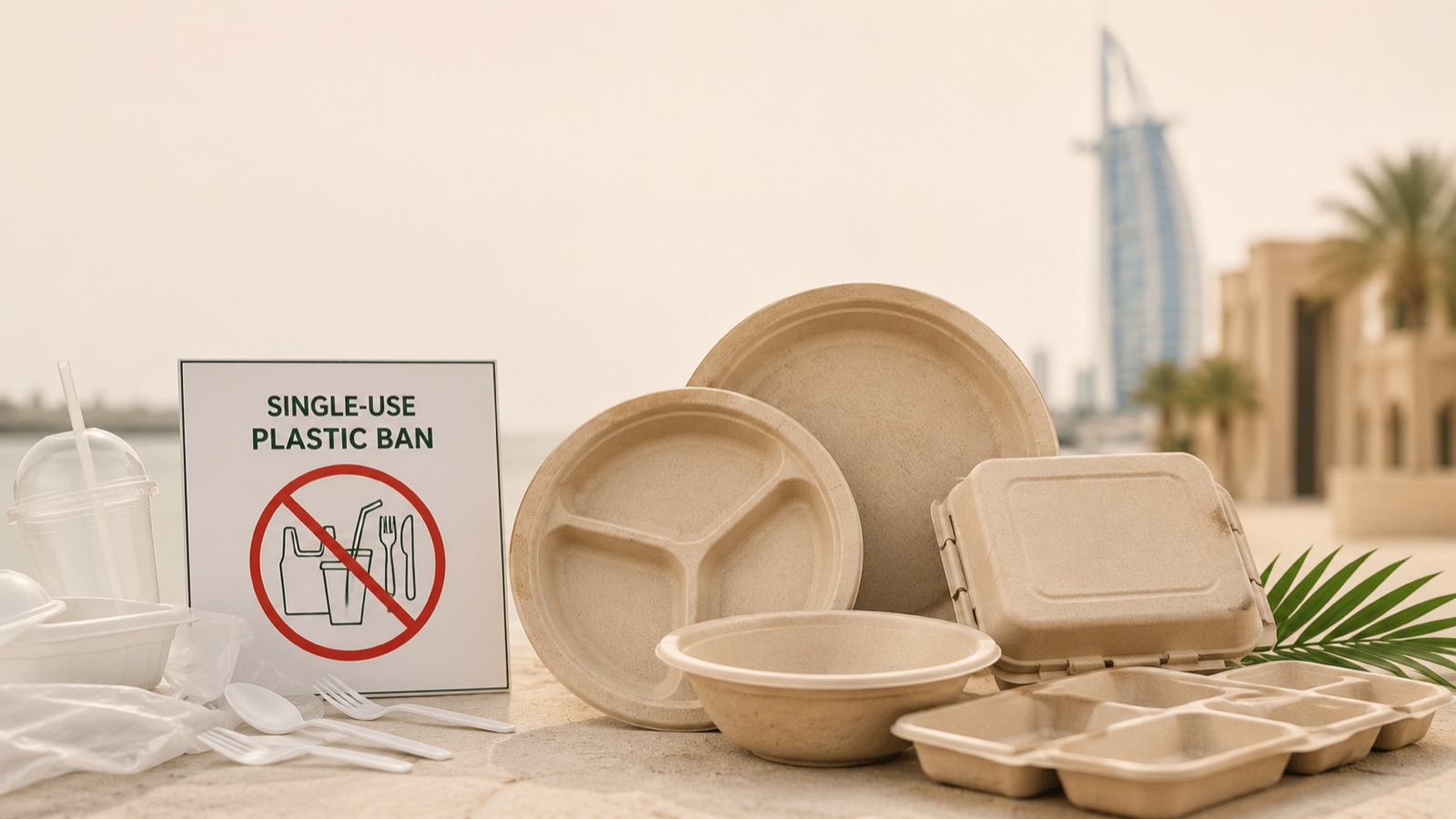
From 1 January 2026 the UAE expanded restrictions on selected single-use plastic products. For foodservice, the affected categories include single-use plastic plates, cutlery, beverage cups and lids, straws and stirrers, and expanded-polystyrene (Styrofoam) food containers, cups and plates. Exact requirements can differ by emirate, so buyers should check both the federal framework and the local emirate rule before sourcing alternatives.
| Question | Quick answer |
|---|---|
| Is the ban currently active? | Yes, the 2026 phase is in force. |
| Does it affect foodservice packaging? | Yes, plates, cups, lids, cutlery and foam-container categories are covered. |
| Are all non-plastic products automatically compliant? | No. Food-contact safety and local requirements must still be verified. |
| Is the rule identical in every emirate? | Federal rules apply nationally, but emirates add their own requirements. |
Ban status and effective dates
| Measure | Effective |
|---|---|
| UAE nationwide expanded restriction | 1 January 2026 |
| Dubai final phase (plates, cutlery, cups, lids) | 1 January 2026 |
| Abu Dhabi expanded-polystyrene restrictions | 1 June 2024 |
This guide provides general sourcing information and is not legal advice. Importers and foodservice operators should confirm current requirements with the relevant UAE authority before placing commercial orders.
UAE single-use plastic timeline
Dubai’s phased rollout runs under Dubai Executive Council Resolution No. 124 of 2023, aligned with the federal framework in UAE Ministerial Decision No. 380 of 2022.
- 1 January 2024: Dubai bans single-use plastic carrier bags.
- 1 June 2024: Dubai extends the restriction to all single-use bags.
- 1 June 2024: Abu Dhabi bans specified single-use Styrofoam foodservice products (cups, lids, plates, beverage containers and ready-to-eat food receptacles).
- 1 January 2025: Dubai bans Styrofoam cups, plates and food containers, plus plastic straws, stirrers, table covers and cotton buds.
- 1 January 2026: Dubai’s final phase bans single-use plastic plates, cutlery (including chopsticks), and beverage cups and lids; a UAE-wide restriction on importing, manufacturing and trading the expanded list also applies.
Which foodservice products are restricted?
| Product | Status | Typical use | Alternative to evaluate |
|---|---|---|---|
| Single-use plastic plates | Restricted (2026 phase) | Restaurants, catering, events | Bagasse plates or reusables |
| Plastic cutlery | Restricted | Takeaway, delivery | Wooden or fibre cutlery, reusables |
| Plastic beverage cups + lids | Restricted (covered categories) | Cold drinks, takeaway | Paper-based or reusable cups, fibre lids |
| Plastic straws / stirrers | Restricted | Beverages | Paper straws, wooden stirrers |
| EPS / Styrofoam food boxes | Restricted | Takeaway meals | Bagasse clamshells |
| EPS cups and plates | Restricted | Hot and cold foodservice | Bagasse, paper-based or reusable |
| Plastic food trays | Check design and jurisdiction | Catering, meal prep | Moulded-fibre trays |
| Plastic-lined paper products | Product-specific assessment | Cups, takeaway packs | Verify material and local acceptance |
Note: “paper”, “plant-based”, “biodegradable” or “compostable” language does not by itself establish compliance. Verify the full composition, coatings, liners and food-contact documentation.
Do the rules differ between Dubai, Abu Dhabi and the rest of the UAE?
Yes. UAE federal rules provide a national framework, and individual emirates add restrictions, timelines and enforcement. A product suitable for one use should be checked against both the nationwide requirement and the emirate where it will be imported, distributed or used.
| Area | Main framework | Foodservice relevance |
|---|---|---|
| UAE federal | Cabinet Resolution No. 380 of 2022 | National regulation of identified single-use products |
| Dubai | Executive Council Resolution No. 124 of 2023 | Phased restrictions: bags, EPS, plates, cutlery, cups, lids |
| Abu Dhabi | EAD single-use plastic policy | Bag controls and specified EPS foodservice restrictions |
| Other emirates | Federal framework plus local rules | Confirm with the responsible local authority |
Comparing compliant alternatives
The ban targets plastic and foam, and natural fibre such as bagasse sits outside it because it is not a plastic.
Do not assume a compostability claim is an exemption here. MOCCAE describes Ministerial Decision No. 380 of 2022 as imposing “a complete ban on the import, production, and trade of single-use shopping bags, including those labelled as biodegradable”, effective 1 January 2024. So in at least one product category the UAE treats a biodegradable label as no defence at all.
For the 2026 categories (beverage cups and lids, cutlery, plates, food containers), PLA is widely reported as an accepted alternative alongside paper, wood and recycled plastic. We have not been able to verify that from a UAE government source, and much of the reporting originates with PLA producers, so we present it as unconfirmed rather than as a rule. The recycled-content route also appears to be limited to products made from recycled materials within the UAE, which would not assist an importer.
Practical position for a buyer: bagasse needs no exemption because the ban never engages on a non-plastic material. Any PLA or rPET decision should be confirmed in writing with MOCCAE or the relevant emirate authority for the specific product category before stock is committed.
Choose by application rather than by marketing label:
| Material | Suitable for | Advantages | Buyer checks |
|---|---|---|---|
| Bagasse (molded fibre) | Plates, bowls, trays, clamshells | Plastic-free fibre, hot/oil/moisture safe, PFAS-free, home-compostable | Heat, oil, coating and food-contact reports |
| Paperboard | Cups, cartons, sleeves | Printable, widely available | Plastic lining, barrier coating, recyclability |
| Wood | Cutlery, stirrers | Simple plastic-accessory replacement | Strength, splintering, food-contact |
| PLA | Cold cups, some linings | Plant-derived, currently permitted | Heat limits, needs industrial composting |
| rPET | High-volume cold beverage | Permitted as certified recycled content | Recycled-content proof, labelling burden |
| Reusables (steel, ceramic, durable plastic) | Dine-in, controlled service | Multiple-use, lowest lifecycle impact | Washing infrastructure, logistics, take-back |
Bagasse tends to be the safer default for hot and oily foodservice (it handles heat and grease without a plastic liner, is PFAS-free, and breaks down without an industrial composting facility, which PLA usually requires). Where collection and washing exist, reusables can be the better long-term choice, no single material is the answer for every use. Compare materials in bagasse vs paper and bagasse vs PLA.
What UAE importers should request
The rules cover import, manufacture and trade, so distributors and importers carry the compliance risk. Before ordering, request:
- Material specification and full structure (base material, coatings, liners, additives).
- Food-contact documentation: declaration of conformity, migration test reports, heavy-metal testing.
- Performance data: heat, oil, moisture and leak testing for your actual use.
- Supply-chain records: country of origin, batch traceability, HS code, carton dimensions.
- Environmental-claim evidence: certification scope and standard for any “compostable”, “plastic-free” or “PFAS-free” claim.
Where Ecofy fits
Ecofy manufactures ban-relevant bagasse plates, bowls, clamshells, trays and containers and ships factory-direct to UAE importers, distributors and HORECA. Ecofy can provide available product specifications and supporting test documentation for buyer review; final market acceptance should be confirmed by the UAE importer and the relevant local authority.
Explore the UAE market page for shipping and terms, browse bagasse clamshells and containers, or, if you sell under your own name, see private-label and OEM supply. Ready to switch? Request a UAE quote.
Official UAE regulatory sources
- Dubai Municipality, Single-use products
- Dubai Executive Council Resolution No. 124 of 2023
- Environment Agency Abu Dhabi, Styrofoam restrictions
- UAE Ministerial Decision No. 380 of 2022 (federal single-use products framework)
Regulatory review completed July 2026 by the Ecofy Export & Technical Team.
Ecofy’s position on UAE compliance
Ecofy manufactures compostable molded fiber foodservice packaging in India and supplies distributors across the GCC.
- Plastic-free by material, not by coating. Our compostable plates, bowls, clamshells and trays are made from sugarcane bagasse, so they sit outside single-use plastic restrictions rather than needing an exemption.
- Documentation ships with the goods. BRCGS Grade A facility certification, food-contact migration testing and PFAS-free verification by SGS and Intertek travel with every order. See the full certifications hub.
- Exporting since 2020 to more than 30 markets, so the paperwork a UAE importer needs is routine rather than a special request.
If you are replacing restricted foodservice items for the UAE market, we can quote against your current specification and send samples for approval. Request a quote and documentation and we respond within 48 hours.
Want guides like this in your Google results?
Add Ecofy as a preferred source. Google will surface our compliance standards and trade-data guides more often when you search packaging rules, including in AI Overviews. Takes one click and you can remove it any time.