UK Plastic Packaging Tax: Calculator and Compliance Guide
UK PPT explained. £228.82/tonne rate, exemptions, compostable bagasse advantage, registration requirements.
On this page
Sourcing in bulk?
Tell us your products and quantity
We supply distributors and brands in 30+ countries, and reply with pricing, lead time and shipping.
Short answer: The UK Plastic Packaging Tax charges 228.82 pounds per tonne, the 2026-27 rate, on plastic packaging containing less than 30 percent recycled content. Uncoated bagasse and other non-plastic fibre packaging sits outside the tax entirely, which changes the landed-cost comparison for UK buyers.
The UK Plastic Packaging Tax (PPT) took effect on 1 April 2022 and now sits at £228.82 per tonne (2026-27 rate, effective 1 April 2026, per HMRC) on plastic packaging with less than 30% recycled content. For foodservice operators importing or producing plastic clamshells, takeaway containers, and lids, the tax has materially shifted the economics of compostable alternatives.
Useful first step: try the UK Plastic Tax Calculator to estimate your annual exposure.
How much is the Plastic Packaging Tax?
£228.82 per tonne for the 2026-27 year, from 1 April 2026. The charge applies to plastic packaging components containing less than 30% recycled plastic.
The rate is index-linked and has risen every April since launch:
| From 1 April | Rate per tonne |
|---|---|
| 2022 | £200.00 |
| 2023 | £210.82 |
| 2024 | £217.85 |
| 2025 | £223.69 |
| 2026 | £228.82 |
Rates are published by HMRC on the Plastic Packaging Tax guidance, with the full set of notices in the GOV.UK PPT collection. That is a 14.4% increase in four years, which is why buyers modelling a switch usually run a three-year horizon rather than a single year. Exposure that looks tolerable now grows automatically.
Worked example: 50 tonnes of plastic packaging below the recycled threshold costs 50 × £228.82 = £11,441 a year. To convert units to tonnes, multiply item count by item weight in grams and divide by one million. One million clamshells at 15g each is 15 tonnes.
Who pays the tax
PPT applies to:
- UK manufacturers producing plastic packaging
- Importers bringing plastic packaging into the UK (whether empty or as part of a finished product)
- Operators producing or importing more than 10 tonnes of plastic packaging per year
A foodservice chain importing plastic clamshells from China or India is liable as the importer, even if the chain operates the outlets through franchisees. Switching to compostable bagasse clamshells removes the liability entirely. If you are sourcing that switch, our guide on how to import bagasse tableware from India covers HS codes, certifications and customs documents.
What’s taxable
- Plastic packaging containing less than 30% recycled content by weight
- Includes virgin plastic clamshells, takeaway containers, lids, films, and films-with-paperboard composites
- Tax applies to the plastic component only; the paperboard or other non-plastic components are not taxed
Plastic Packaging Tax exemptions, and what is simply out of scope
These are two different mechanisms and conflating them causes most of the confusion in this area.
Out of scope: the material is not plastic. Bagasse moulded fibre, pulp, paper, glass and metal are not plastic packaging, so the tax never engages. There is no exemption to claim, no threshold to meet and no recycled-content documentation to keep.
Exempt or not chargeable: the material is plastic, but it qualifies. Three main routes:
- Plastic packaging with 30% or more recycled content, evidenced through chain-of-custody documentation
- Plastic packaging used for licensed human medicines
- Transport packaging used to import goods into the UK, such as bulk shipping pallets, though not the consumer-facing packaging inside
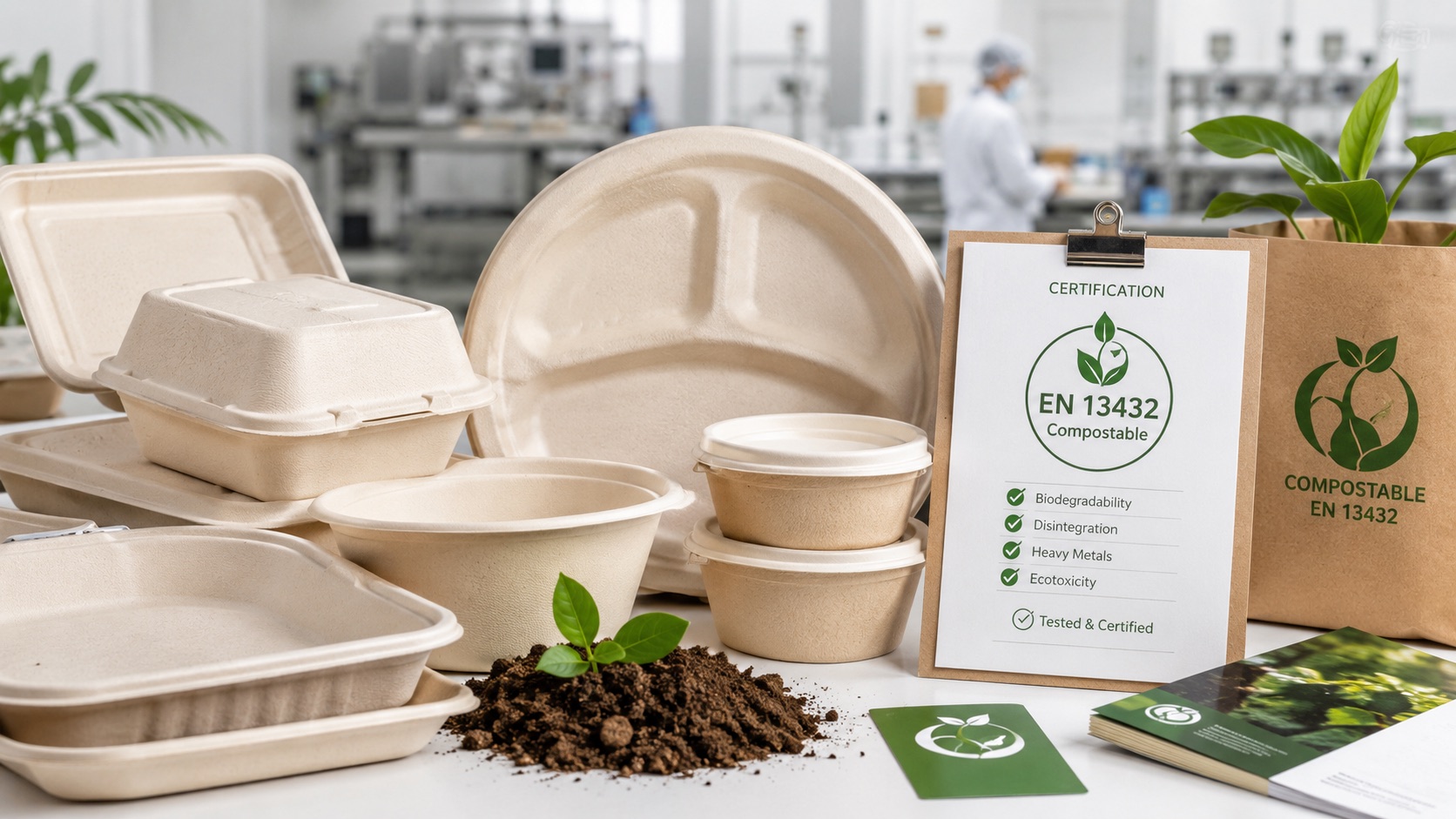
Not exempt, though often assumed to be: compostable, biodegradable and oxo-degradable plastic. HMRC’s guidance states plainly that plastics “include polymers which are: biodegradable, compostable, oxo-degradable”, so an EN 13432 certificate does not remove the charge. This is the most common misreading of the four compostability standards and what each one proves. See HMRC guidance on which packaging is subject to the tax.
What changes on 1 April 2027, and why it matters now
Two changes take effect on the same date, and together they move some packaging into charge without anything about the packaging itself changing.
Pre-consumer waste stops counting. Today, recycled content can come from either pre-consumer plastic (production off-cuts, factory scrap, in-house regrind) or post-consumer plastic. From 1 April 2027 that ends. HMRC’s consultation document states that “pre-consumer waste will no longer be classified as recycled plastic for the purposes of PPT and only reprocessed post-consumer plastic waste will be accepted”.
A mass balance approach arrives for chemically recycled plastic. The same document confirms “a MBA will be permitted for use by businesses from 1 April 2027”, allowing chemically recycled feedstock to be attributed to finished packaging even where it is blended with virgin plastic, provided it is tracked and certified.
What this means for a buyer. If a supplier currently clears the 30% threshold using factory scrap or regrind, that component becomes chargeable in April 2027 at the prevailing rate. The specification does not change, the packaging does not change, and the tax position does. Anyone modelling packaging cost on a three-year horizon should be asking suppliers which type of recycled content underpins their 30% claim, not simply whether they meet it.
Source: HMRC, Plastic Packaging Tax: potential certification for mechanically recycled plastic packaging, which confirms “these changes will take effect from 1 April 2027”.
Fibre is unaffected either way. Bagasse is not plastic, so neither the threshold nor its definition applies.
Why bagasse sits outside the tax entirely
Compostable plastics (PLA, PHA, PBAT) get no exemption for being compostable. Because HMRC’s definition of plastic expressly covers biodegradable, compostable and oxo-degradable polymers, switching from conventional plastic to a certified compostable plastic changes the material but not the liability. For a plastic component the only route out of the charge is 30% or more recycled content, evidenced with chain-of-custody records that HMRC can audit.
That recycled-content route is open to compostable plastic in principle, on the same test as conventional plastic. In practice it is hard to use, because HMRC defines recycled plastic as material reprocessed from pre-consumer or post-consumer plastic waste by a chemical or mechanical process and states that it “does not include organic recycling”. Composting the finished product therefore counts for nothing against the threshold; only recycled plastic feedstock does. From 1 April 2027 the definition narrows further, to post-consumer waste only.
The distinction that matters for fibre is different. HMRC treats “cellulose-based polymers that have not been chemically modified” as non-plastic, which is why uncoated bagasse fibre is outside the scope of the tax while a PLA lining or a PET lid is not.
Bagasse is not plastic. It sits outside PPT scope entirely: no exemption claim to file, no documentation overhead, no classification dispute to lose.
Calculating annual exposure
Estimating PPT exposure for a typical QSR chain:
- Average plastic clamshell weight: ~25 g
- Annual containers per outlet: ~80,000
- Outlets: 50
- Total annual plastic weight: 25 g × 80,000 × 50 = 100,000 kg = 100 tonnes
- PPT exposure: 100 tonnes × £228.82 = £22,882 per year
For a 200-outlet chain, exposure quadruples to ~£91,528 annually. For chains operating in the UK with imported Chinese plastic clamshells, this is now a top-line P&L item, and switching to bagasse eliminates it entirely.
Cost-of-switching math
Compostable bagasse SKUs typically run 15-25% above virgin plastic on unit cost at FCL volumes. For the 50-outlet chain example above:
- Plastic clamshell unit cost: £0.085 each
- Bagasse equivalent unit cost: £0.103 each (+21%)
- Annual unit cost increase: £0.018 × 4,000,000 containers = £72,000
- Plastic Tax saving: £22,882
- Net cost increase: £49,118 (offset by ~32% via tax saving)
For chains importing higher-weight plastic clamshells or operating at larger scale, the tax saving alone can fully offset the unit-cost premium. The break-even point depends on plastic weight per piece and total volume.
Reporting and registration
UK PPT registration is required if you produce or import 10+ tonnes of plastic packaging in any rolling 12-month period. Quarterly returns to HMRC due 30 days after each quarter end. Records must be retained for 6 years.
Ecofy and UK PPT
Ecofy’s bagasse molded fiber products fall outside PPT scope entirely: no plastic content. PET lids on takeaway containers are plastic and would be subject to PPT, but their weight is typically 14-21 g (vs 25-40 g for full plastic clamshells), reducing the tax exposure proportionally. Most Ecofy customers switch the high-volume bagasse clamshell container and bagasse bowl SKUs to bagasse and accept the smaller PET-lid PPT exposure. Wholesale pricing is available for chains buying at FCL volumes.
Want guides like this in your Google results?
Add Ecofy as a preferred source. Google will surface our compliance standards and trade-data guides more often when you search packaging rules, including in AI Overviews. Takes one click and you can remove it any time.