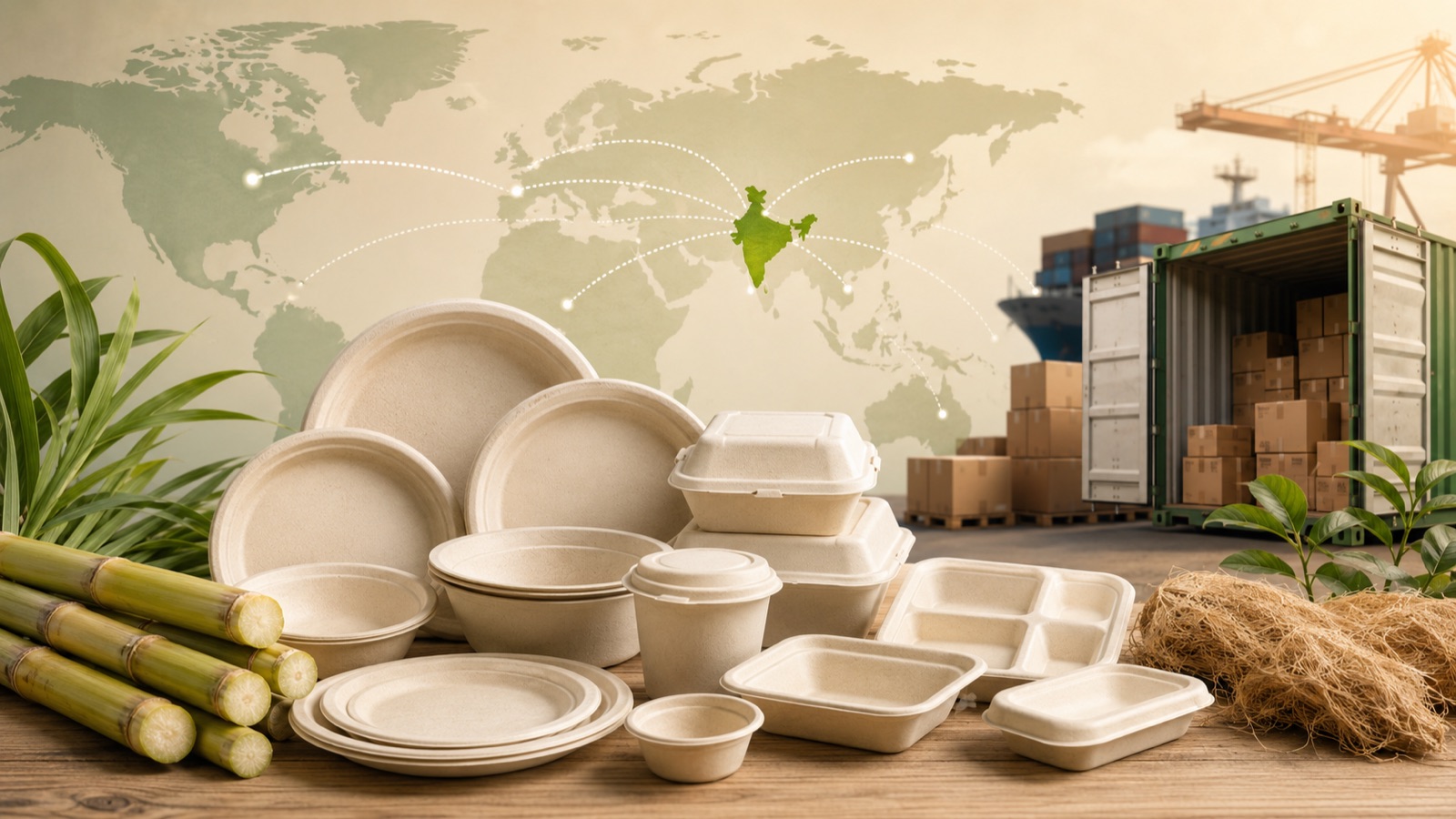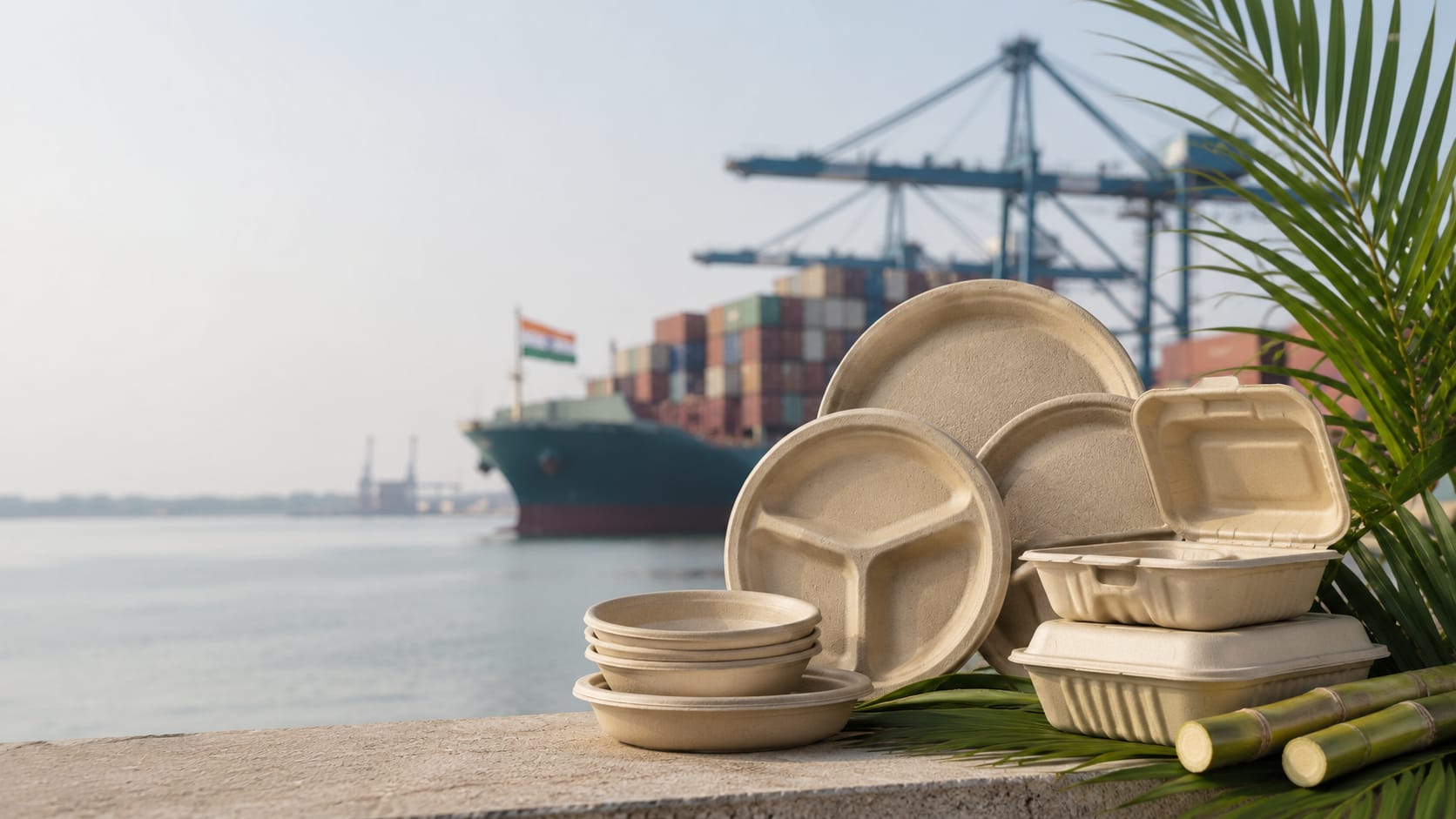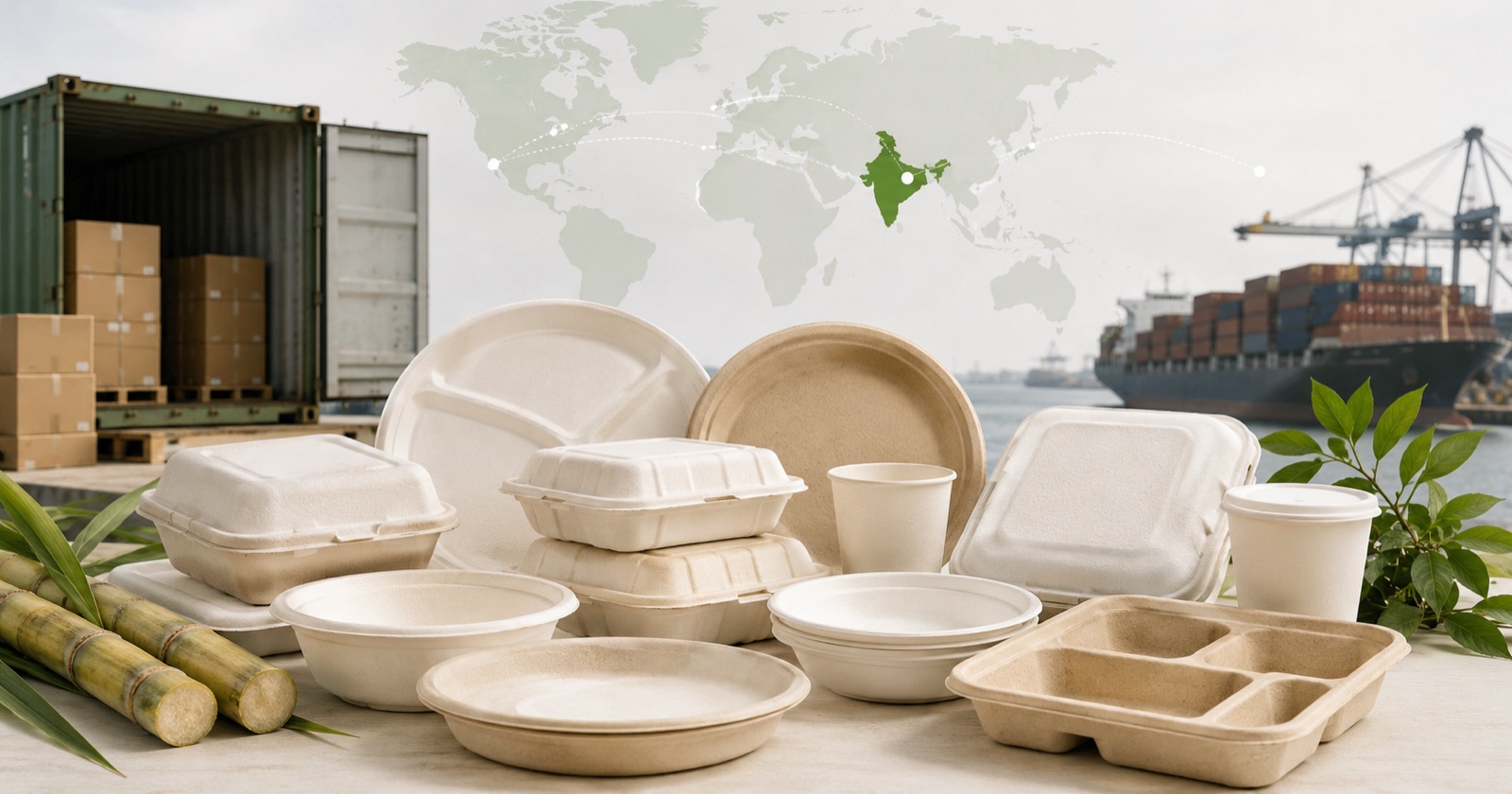
Bagasse Tableware MOQ, Lead Time and Container Planning: A Bulk Buyer's Guide
How MOQ, lead times, 20ft/40ft container loading, and FOB/CIF/DDP terms work when sourcing compostable bagasse tableware in bulk. A practical planning guide for distributors and importers.
On this page
Sourcing in bulk?
Tell us your products and quantity
We supply distributors and brands in 30+ countries, and reply with pricing, lead time and shipping.
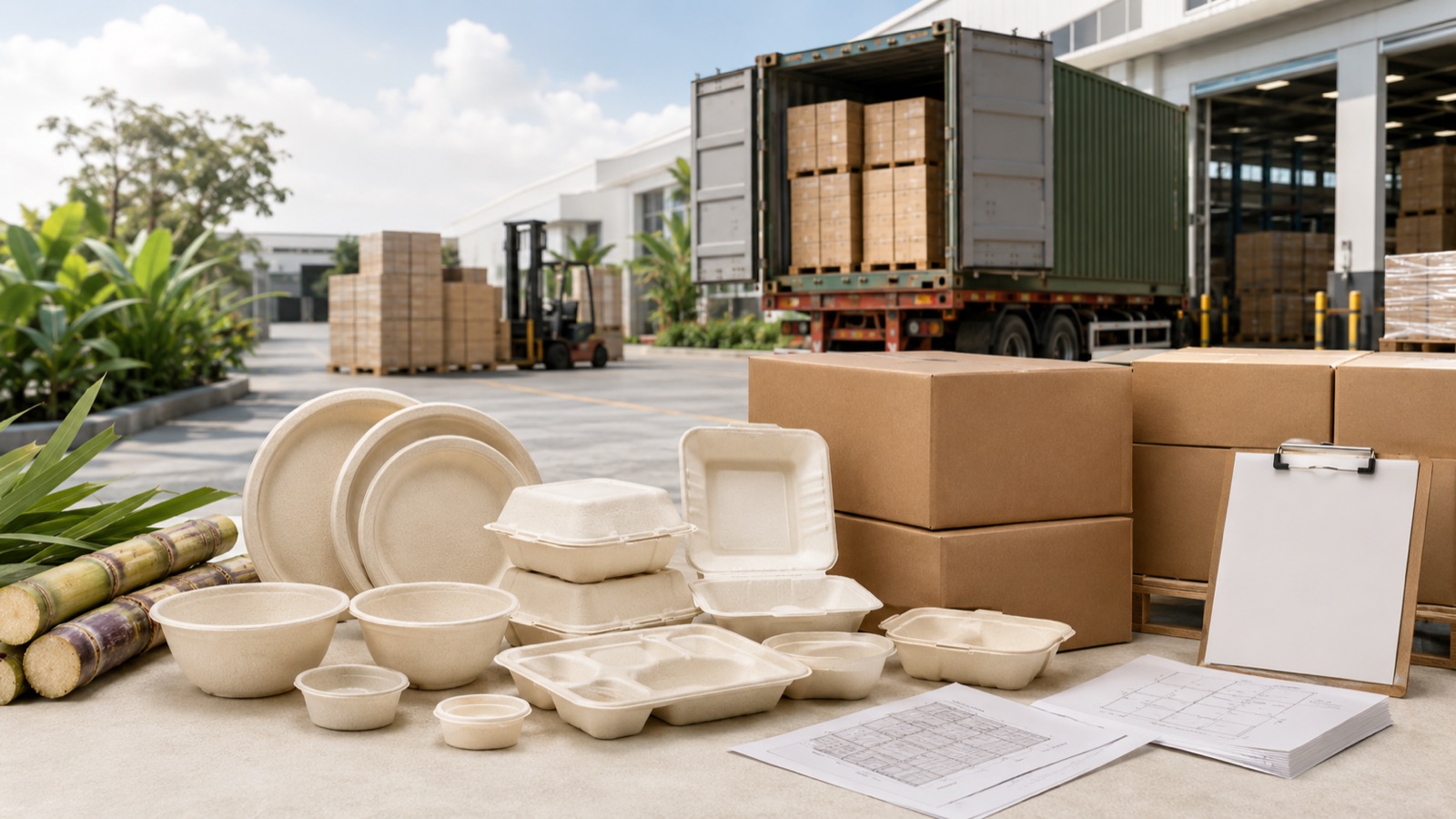
If you are sourcing compostable bagasse tableware in bulk for the first time, four things decide your landed cost and your delivery date: the minimum order quantity, the production lead time, how much product fits in a shipping container, and the Incoterms your quote is based on. This guide explains each one, including the container-loading math most suppliers leave out, so a distributor, importer, or foodservice buyer can plan a first order with confidence.
Key takeaways
- MOQ is set per SKU, not per order, and across the industry it commonly runs from about 5,000 to 50,000 pieces per item depending on product and customisation.
- You do not need a full container of one product. Most buyers combine several SKUs into one container to keep freight per unit low.
- Container quantity is planned by volume, not weight, because bagasse is light and bulky.
- Plan the whole timeline, not just production: sample approval, production, documentation, and ocean transit.
- FOB, CIF, and DDP each shift a different amount of the shipping work onto you or the supplier.
What minimum order quantity (MOQ) means for bagasse tableware
MOQ is the smallest quantity a manufacturer will produce in a single run. For molded fiber and bagasse products it exists because each SKU runs on its own mold, and a run carries a fixed setup cost that only makes economic sense above a certain volume.
Three points every bulk buyer should know:
- MOQ is per SKU, not per order. A run of 8 inch bagasse clamshells and a run of 6 compartment meal trays are separate setups, each with its own minimum. A single bagasse meal tray size is one SKU; a different compartment count is another.
- MOQ can be quoted in cartons or in pieces. Because pieces per carton vary widely (a stack of thin compostable bagasse plates packs very differently from bulky bagasse takeaway containers), always confirm the unit before you compare and vet suppliers.
- Customisation raises the minimum. Stock white or kraft items carry lower minimums than private-label printed runs, which add tooling and print setup.
Industry MOQs commonly sit anywhere from 5,000 pieces for smaller items to 50,000 pieces per SKU at larger factories. As a factory-direct manufacturer we set minimums to be workable for genuine wholesale buyers rather than retail quantities, and we confirm the exact figure per SKU on your quote.
How to lower your effective MOQ
You have more control than the headline number suggests:
- Mix SKUs in one container. You rarely need a full container of a single item. Combining plates, bagasse bowls, clamshells, and PET bowl lids to fill one container spreads volume across the products you actually sell.
- Start with a sample kit. Check quality on the exact SKUs before committing to a run. You can build a sample kit to shortlist items.
- Consolidate your range. Fewer, higher-moving SKUs at larger volumes usually beat many SKUs at their individual minimums on both price and freight.
Lead times: from quote to delivered container
A bulk order moves through four stages, and the most common planning mistake is budgeting only for production:
- Quote and sample approval. Specs are agreed and a sample kit is checked. Allow time here before the clock on production even starts.
- Production. Typically around two to four weeks, with stock items faster than custom or private-label runs that add tooling and print steps.
- Documentation and inspection. Certificates, commercial invoice, and packing list are prepared, along with any pre-shipment checks.
- Ocean transit. Sea freight commonly runs several weeks and depends on your destination port. Transit to the USA, UK, and UAE each differs, with the UAE typically the shortest lane from India and North America the longest.
Build sample approval in at the start and ocean transit in at the end, and confirm the current production window at quote, since it moves with order book and season.
Container planning: how much bagasse tableware fits
Bagasse tableware is light but bulky, so a container almost always fills up by volume, not weight. You plan container quantity from carton size, not from tonnage, and you will hit the space limit long before the weight limit.
The method is simple:
- Take the outer volume of one carton in cubic metres (length times width times height).
- Divide the container’s usable volume by the carton volume.
- Apply a loading efficiency of roughly 85 to 90 percent for real stacking.
- Multiply cartons by pieces per carton for the total piece count.
Approximate container volumes:
| Container | Internal volume | Usable (planning) |
|---|---|---|
| 20 ft general purpose | about 33 m³ | about 25 to 28 m³ |
| 40 ft high cube | about 76 m³ | about 60 to 68 m³ |
Worked example. If a carton measures 0.5 by 0.4 by 0.4 m, that is 0.08 m³. A 20 ft container (about 28 m³ usable) holds roughly 300 cartons, and a 40 ft high cube (about 68 m³) roughly 760 cartons. At 1,000 pieces per carton that is about 300,000 and 760,000 pieces. These are indicative planning figures; exact carton dimensions and container counts for each SKU are confirmed on your quote.
FOB, CIF, or DDP: what your quote covers
Incoterms are the international rules, published by the International Chamber of Commerce, that define exactly where the supplier’s responsibility ends and yours begins. Three cover most bulk tableware orders:
| Term | What the price covers | Best for |
|---|---|---|
| FOB (Free On Board) | Goods loaded onto the vessel at the origin port | Buyers with their own freight forwarder and rates |
| CIF (Cost, Insurance and Freight) | Freight and insurance to your destination port | Buyers who want one landed-to-port figure |
| DDP (Delivered Duty Paid) | Delivery to your door, duties included | First-time importers who want the supplier to manage everything |
FOB gives you the most control and usually the lowest quoted price, but you take on freight and insurance. CIF simplifies to a single port figure. DDP is the easiest for a first import because the supplier handles the chain end to end. We quote wholesale orders on FOB or CIF to more than 30 countries, so you can compare against your own forwarder’s numbers. For the full breakdown, who pays for what at each stage, which term suits your first order, and the India-specific detail, see our FOB vs CIF vs DDP guide.
Documentation and certifications you should receive
Treat the document pack as part of the product, because it is what clears customs and satisfies your compliance team. For a compostable tableware shipment, confirm the following travel with the order or are available on request:
- Commercial invoice and packing list with carton and pallet detail
- Compliance certificates relevant to your market, for example EN 13432 for the EU and UK, FDA food contact documentation for the USA, and BRCGS food safety certification
- Material and PFAS-free declarations where your market requires them
If you sell into the UK, bagasse also sits outside the scope of the UK Plastic Packaging Tax, which is a line-item saving worth documenting for your buyers.
For the full import process beyond order planning, including HS-code classification, customs documents and per-market compliance, see our guide on how to import bagasse tableware from India. Buyers ordering for the domestic market can go straight to factory-direct supply from our India plant.
Planning your first order in four steps
- Shortlist SKUs across the categories you sell and request a sample kit to check quality.
- Confirm MOQ and pieces per carton for each SKU so you can size the order correctly.
- Plan the container by combining SKUs to a full 20 ft or 40 ft load using the volume method above.
- Choose FOB, CIF, or DDP and request a quote with your destination port so the figure is comparable to your landed-cost target.
Get a planned quote
Tell us the SKUs, your destination port, and whether you want FOB, CIF, or DDP, and we will come back with MOQ, pieces per carton, container quantities, lead time, and the document pack. Request a bulk quote or explore wholesale bagasse tableware supply to get started. Planning a branded range? Minimums differ for private-label compostable tableware.
Want guides like this in your Google results?
Add Ecofy as a preferred source. Google will surface our compliance standards and trade-data guides more often when you search packaging rules, including in AI Overviews. Takes one click and you can remove it any time.